It’s been a while! After years of being unsuccessful with the elusive State Library of Victoria Creative Fellowship program I am happy to say that I am deep within my very own Regional Arts Australia fellowship project as we speak. It’s called Heart Maps and it’s based in the beautiful Otways on Gadubanud Country: 6 months connecting with and researching the different layers of the region through people, place and collections, and working towards the creation of a new audio theatre work, woohoo!
I am feeling so honoured to bring together a crack team- Traditional Owner Richard Collopy as cultural advisor and collaborator (see below for my story about him in The Otway Light), Apollo Bay arts legend Jade Forest, musician and producer Aimee Chapman, and the Apollo Bay Museum crew where I will be capturing oral histories, plus of course all the locals who get involved with the project.
I’m running some workshops this weekend at the cool Project Space in Apollo Bay and still have some spots left if anyone would like to join!

And learn more about the awesome work of Richard Collopy below:
The Talking Hut at Cape Otway Light Station (published in Issue 16 The Otway Light 03/06/22)
With Amy Tsilemanis
“In the aboriginal worldview, everything is living. So everything is a manifestation of some other living part. And, of course, with objects that are made, then they’re made by somebody and invested from the person who’s making it and everyone who came before, like the ancestors…So what you make, why you make it, when you make it, is all part of this ancestral cycle of life.” –Margo Neale in First Knowledges ‘Design: Building on Country.’
I arrive through the paths of coastal ti-tree at the hut, alone but for a light rain and the birds. The hut is circular, hand-made with local materials and strangely welcoming amidst its empty, abandoned air. It has no doors, no locks, artefact cases holding only labels, and covered in a layer of disuse. One case reveals a message (a plea?) written with a fingertip through the dust: ‘Please re-open the Talking Hut. We need these spaces.’ I walk past the grime covered information sheets ‘Aboriginal Ground Edge Axes,’ ‘Aboriginal Coastal Shell Middens,’ a broken chair, a fire extinguisher, a Covid sign attached to a branch with a cable tie, greenery coming in through the round, open windows sculpted out of the hut itself, a place to sit half inside half outside. I see the old information board shoved into a makeshift cupboard that states ‘The shells are fragile, the story is precious.’ Empty as the hut appears, I know that there is life here yet. Like Margo Neale’s words above, life has been transferred into the walls, the spiral roof, and the walking track outside. This Talking Hut still has more to hear, more to say.
Today I am lucky to be meeting with the artist and builder behind this special place, Richard Collopy and family. They are Traditional Custodians, and when they arrive they show me a map on the wall of Victoria’s almost forty Indigenous language groups, explaining how Victoria is language rich due to the fertile land. They point out the southern Gunditj (groups) of the Otways area, all surviving.
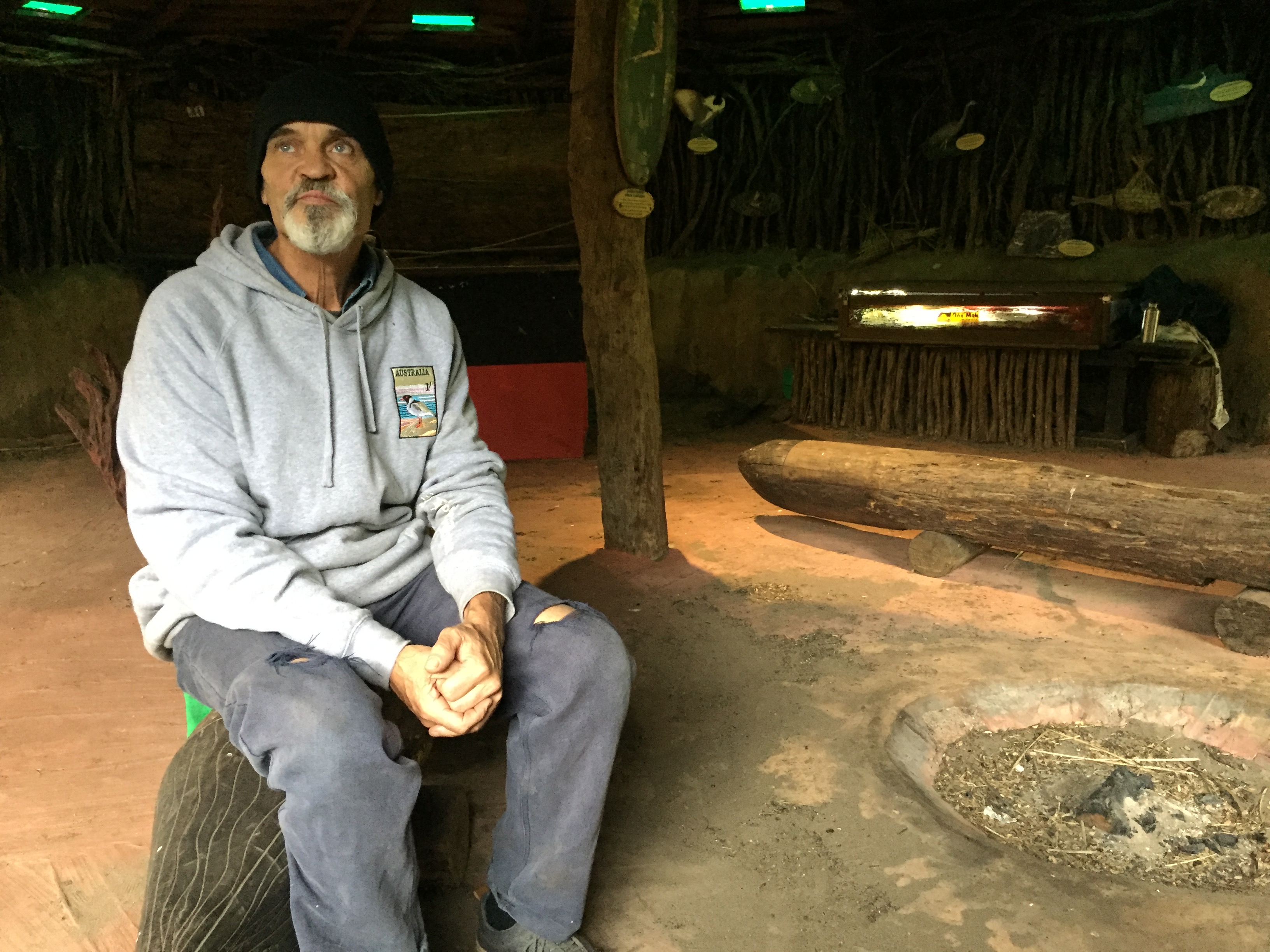
Gadubanud Traditional Owner Richard Collopy inside The Talking Hut. Cape Otway, 2022
We sit on the carved wooden seats around the fire pit. As we talk, the rainfall deepens. Despite the lack of a fire, there’s a sense of cosiness, of hearth, though also of something once lively, sleeping and dusted with days untouched, waiting for its moment to return. As Richard says, it is culture waiting to be reinvigorated. The hut has been closed since Covid disruptions at the Cape Otway Light Station and the Collopy’s are hopeful for a renewed relationship with the site as operations are handed over from private operators to the government body and public land manager Great Ocean Road Coast and Parks Authority (GORCAPA) next month.
Going back over a decade Richard tells me how “knowing that surrounding sites and this place were very unprotected, and with no profile for Aboriginal people, we sought a grant to put our presence here.” With their business they received a federal government grant to create a keeping place for significant cultural artefacts, the hut and a kilometre long walking track. Richard states that “supported by the Light Station business, we established a collective working group including individuals from variant indigenous families, community orgs and others. As Project Manager, this is a role I had experience in before.”
The project sought to bring together the complex threads of recognising the long history preceding European settlement, and the continuing lines of Traditional Custodians like the Gadubanud surviving, despite horrific massacres and displacement due to colonisation. There is much healing to be done, which involves truth-telling to correct historical narratives of ‘savagery’ and ‘extinction,’ and sharing the rich culture and knowledge of the world’s first peoples and their unique stories of the Cape Otway area. These were all drivers in creating the hut, and driving preservation of significant artefacts that tell these stories.

The Talking Hut on a rainy day in 2022
So how did Richard go about building the Talking Hut and what are some of the ideas and symbols within?
“Once we decided to make something here, it took about a year and a half and a bit to see what you’ve got here. All done by hand with second-hand materials, up to thirty individuals helped. I loved building it, we had all our children here, some people that we’ve now lost, they’ve all touched it.” Richard tells the story of crawling on his knees through the bush to this spot where there was nothing, and of using his unique design and building process, where existing materials are shaped and reimagined through a person’s creativity, “tactile and sculptural.”
“I walked out here into the bush, there was nothing here, and I found a bunch of rubbish. There were bits of rock, there were hundreds of bottles, plenty of ti-tree that had to be cut.” Mixed with timber from his own property nearby, the hut was lovingly constructed, large enough for meetings, and inspired by traditional techniques where:
“In some larger huts a timber pole [tree] in the centre was turned upside down so that the roots would form the structure, rocks were built up to about a metre then the timber from the top joins down and the whole lot is covered in grass or sodden, like the thatched technique, then mud and every year your shells that you burn would go on, so they’d need to be re-rendered each year for thousands of years, and that gives it the sense of permanence. The huts are permanent, the people not so much, that’s the difference.”
Standing outside in the rain and looking at the hut I ask about the Y shape at the peak of the roof. Richard tells me about this symbol, in a shape like a whale’s tail: “it features in the hut, the entrance sign and on our clapsticks and this is about people helping each other. The symbology of that today is about the two cultures working together as one. That was the essence of that.”
I thank Richard very much for sharing his story and here’s to an exciting new phase at the Cape Otway Light Station. I will leave you with some of his brother’s wise words: “Relationships are at the basis of everything, and if we can get that right, things will prosper.” Cheers to that!


