Category

Curation

Teapot Tales!

By Arts, Audio, Curation, Teapot Tales

Teapot Tales with Amy T, Barkly Square Ballarat East

I am excited to introduce my current project Teapot Tales, another creative extravaganza with many parts and partners but always with a comforting cuppa and the themes of friendship, fun, and welcome at its heart. Like so many of us around the hurting world, we are looking for ways to be of service, to connect meaningfully, and to use our skills to contribute good in some small way. As is my way, I have followed my curious nose, and things have converged interestingly in this project, my little offering of joy and collaboration at this moment in time.
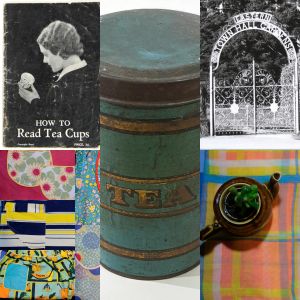
     

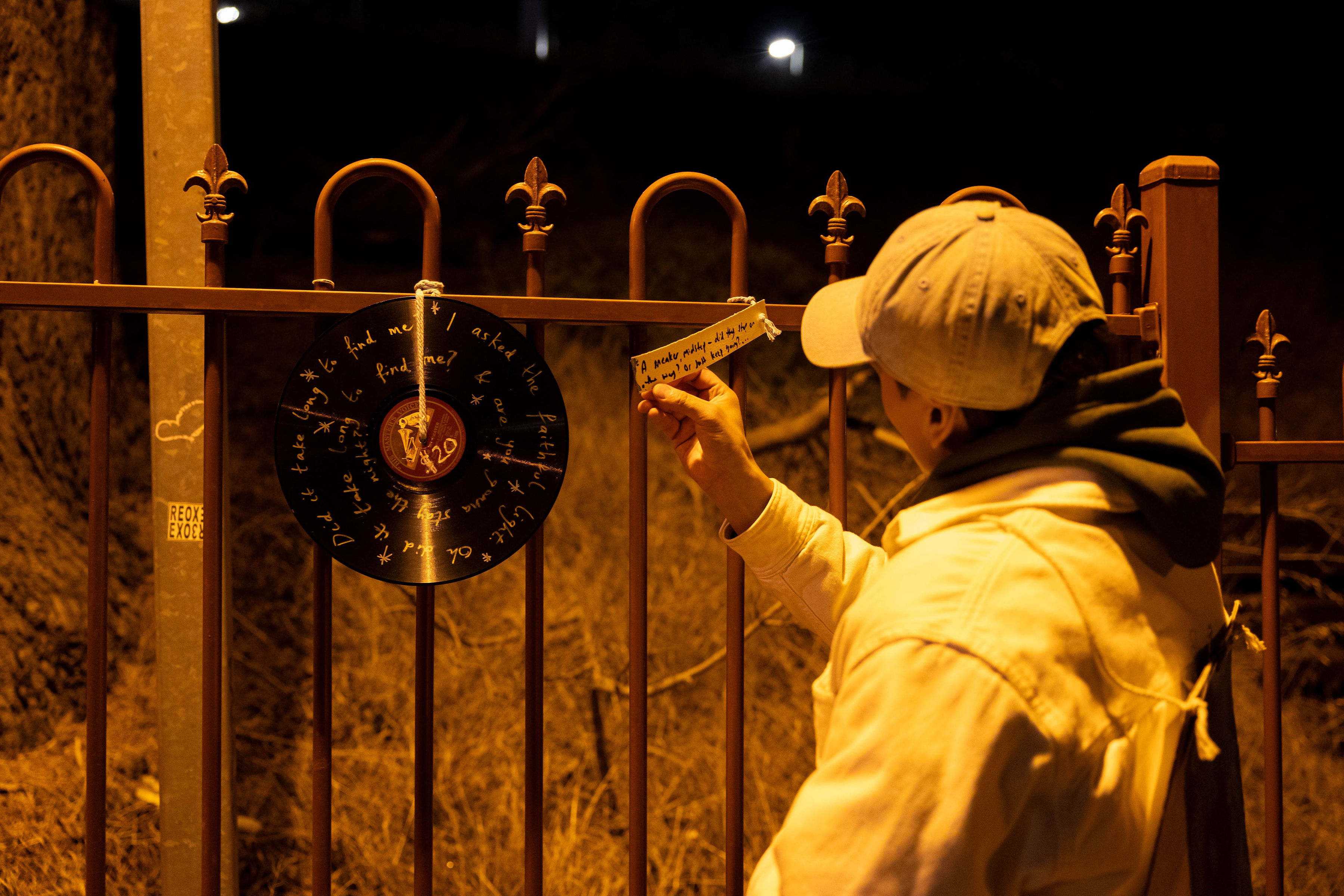
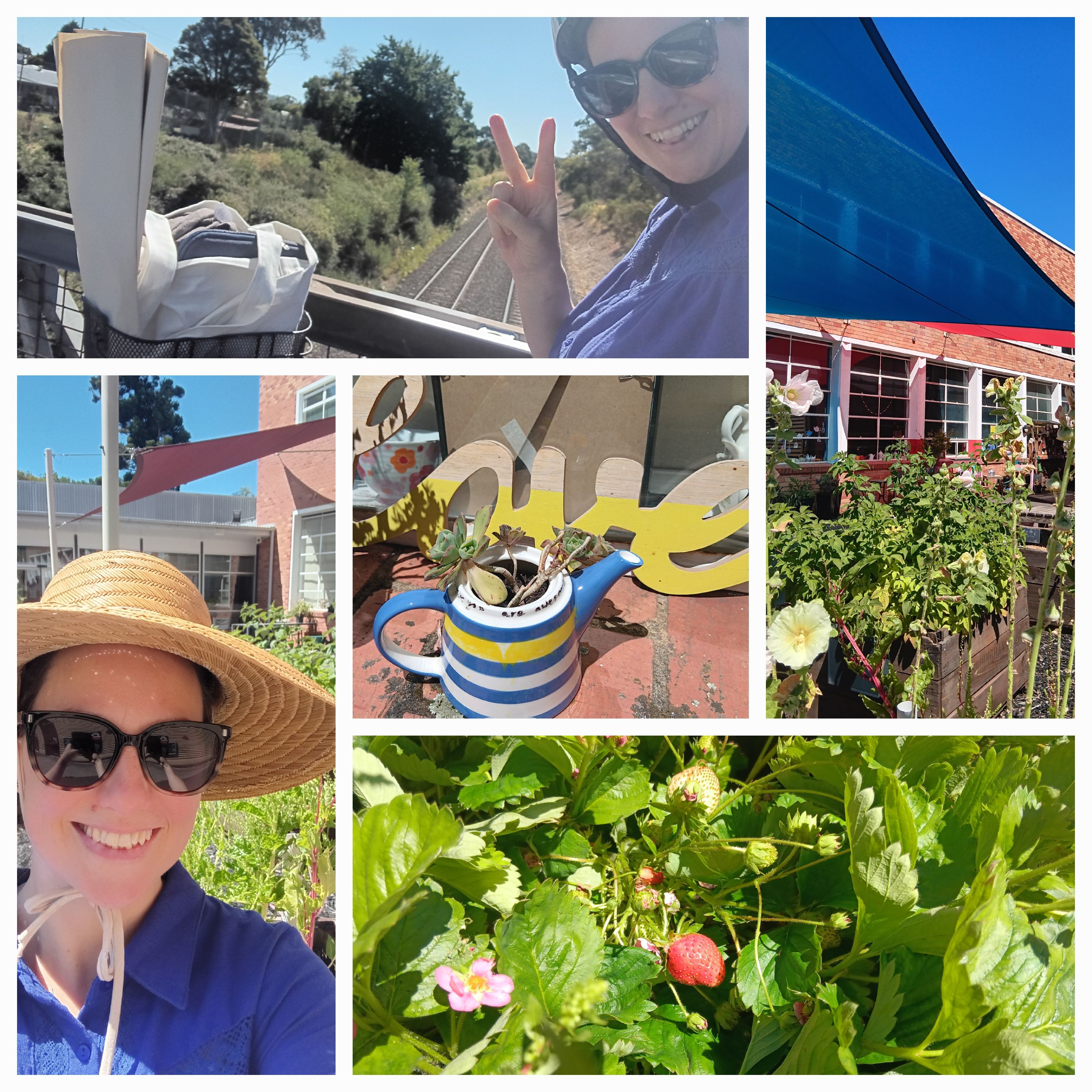
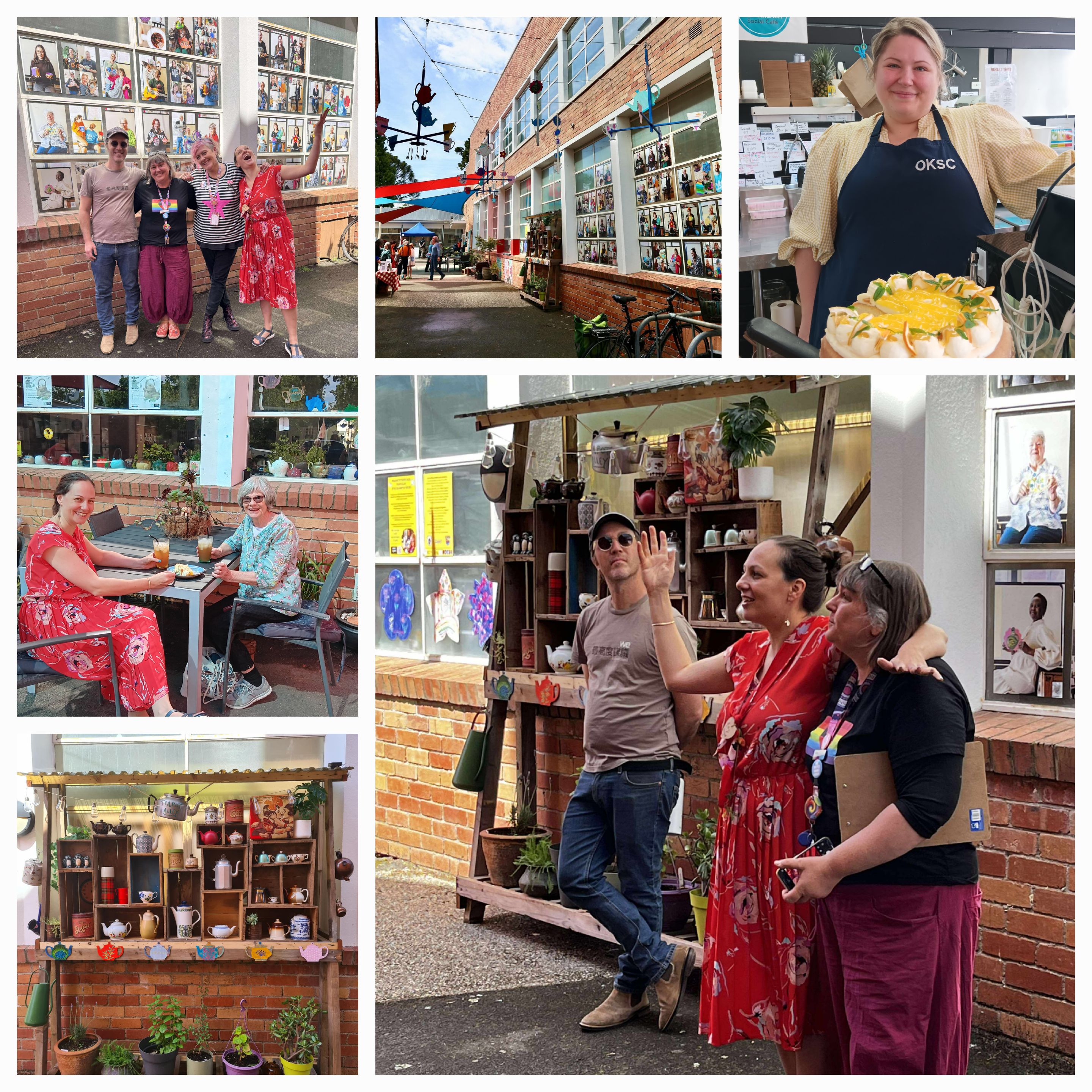
The first workshop people can get involved with is kicking off this Saturday at TBH Studio, where you can come for cuppa and chat and decorate a teapot or teacup (2D and 3D options) that will become part of the art installation I’m creating at Barkly Square in my beloved Ballarat East, Wadawurrung Country.

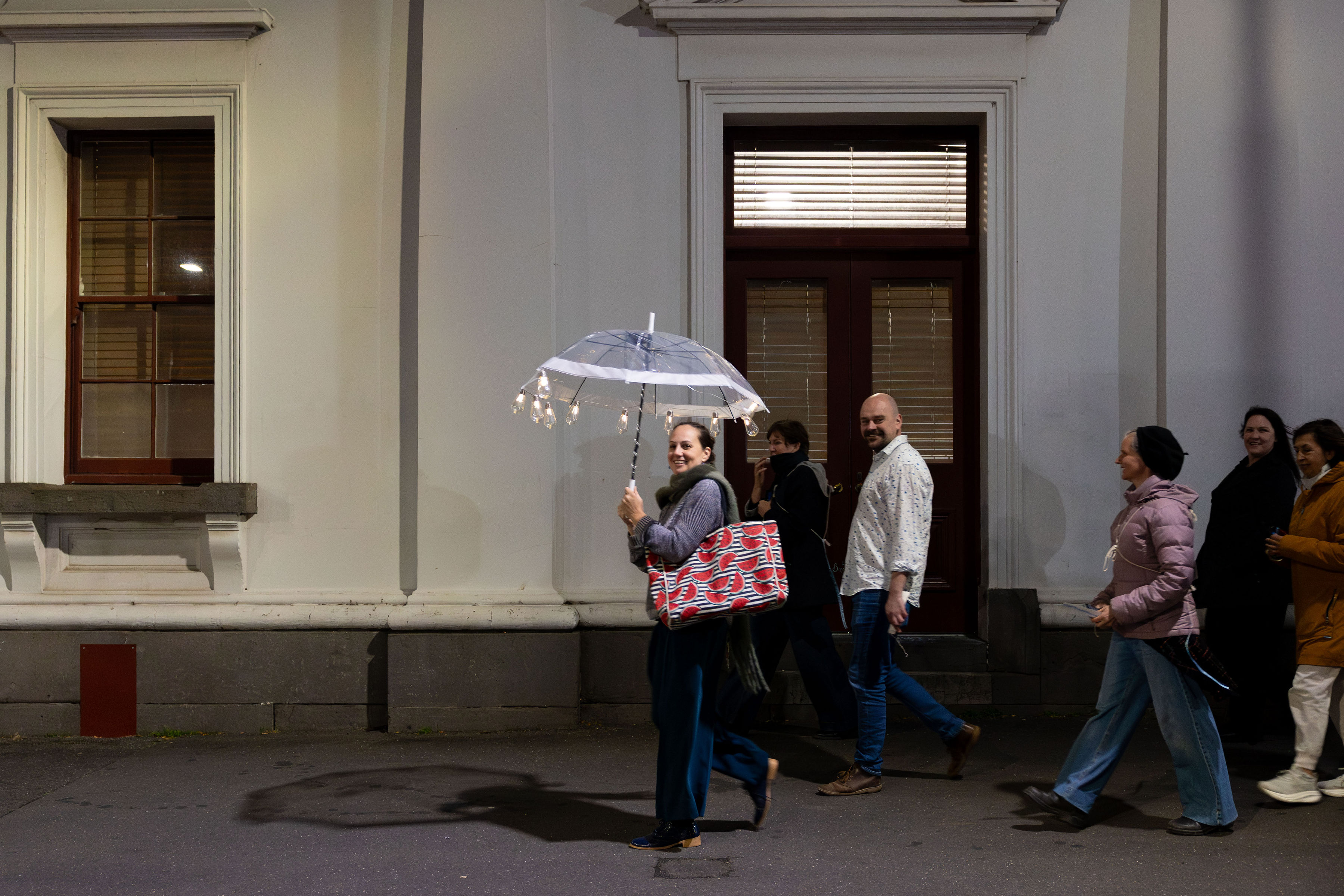
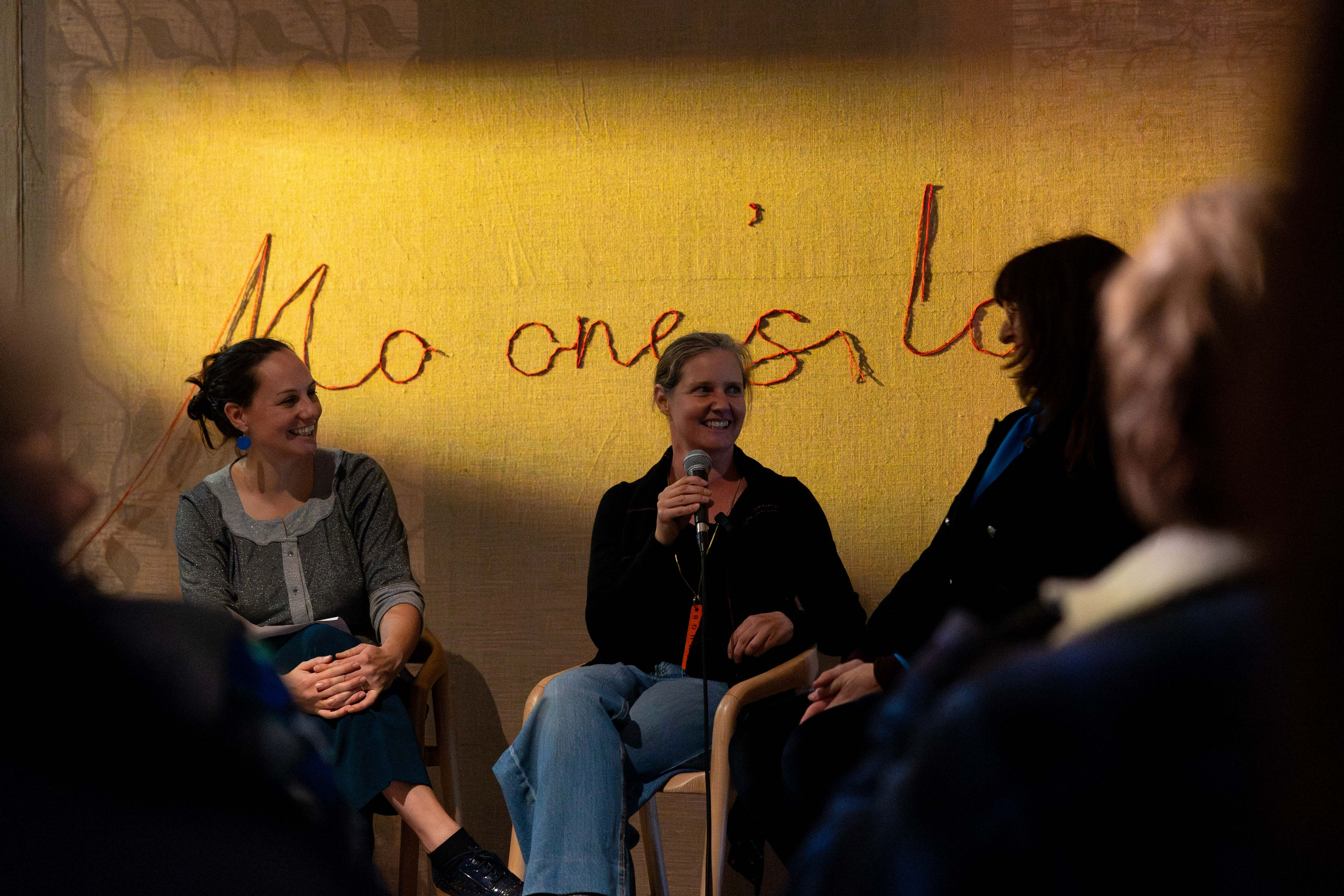
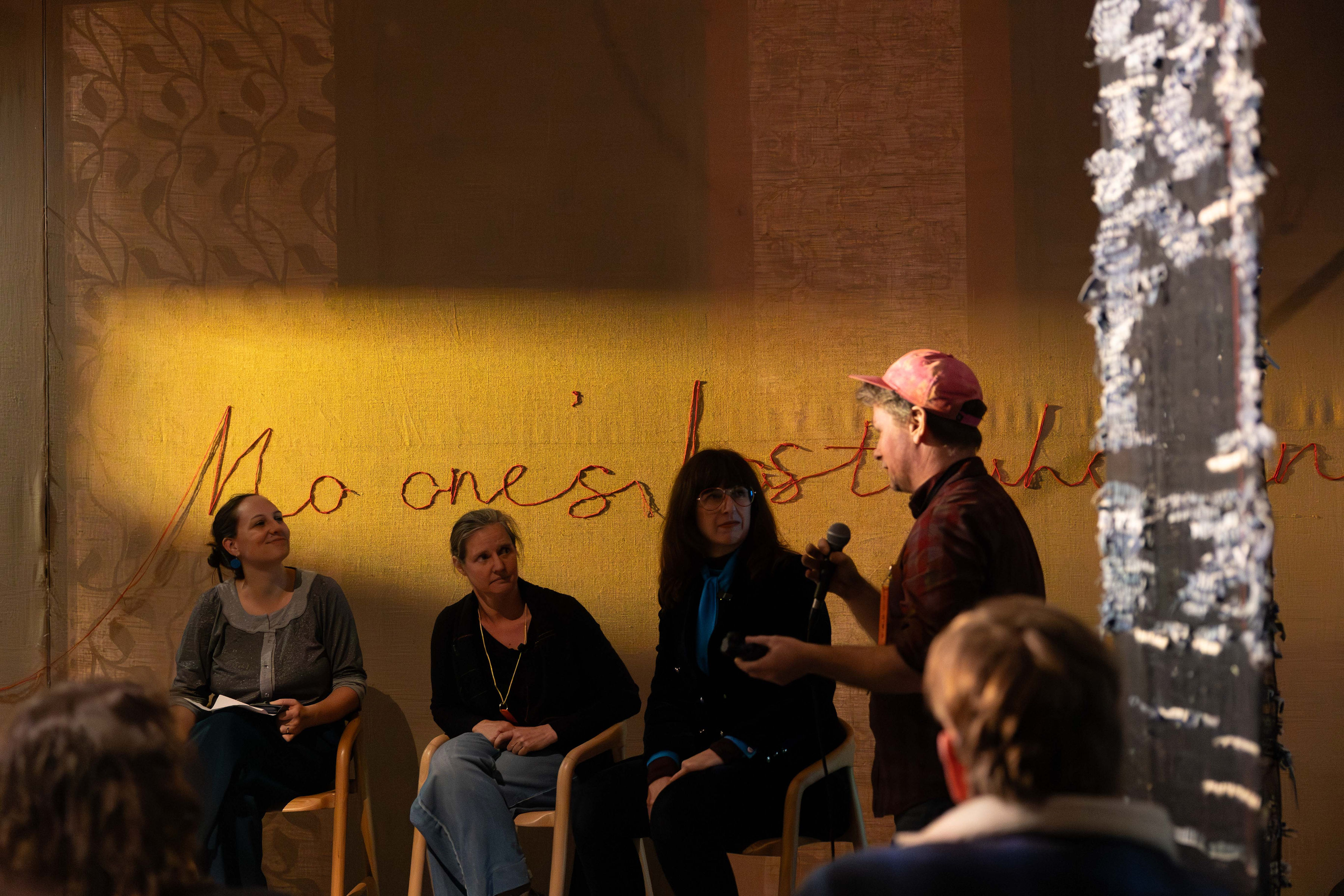
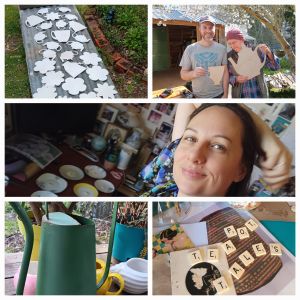
With support from Regional Arts Victoria, I’m also pumped to have photographer Diana Paez on board to take people’s portraits with their creations, and of course I’ll be recording audio stories around people’s favourite tea memories, rituals and more! A little taster here to get you thinking of stories you might like to share. It features me and Diana and also two of my wonderful project mentors Mauz Hatcher and Holly Would (mentoring me along with Abbie Matthews and Lou Ridsdale, all pictured below). Legends!


There will be further workshops across various settings- intergenerational program with aged care and playgroup, Centre for Multicultural Youth, Barkly Square Tenants and community, and a September school holiday special- so keep an eye out or drop me a line if you’d like me to visit you or your group to get involved. I’ve set up a page here for info and fun.

Colourful workshop invite for Teapot Tales.           

Big thanks to Barkly Square’s Ballarat Men’s Shed for producing the cut out shapes for me for painting by the community (and delicious tea and lunch in Our Social Kitchen cafe!) plus all the generous donations of teapots! Some of these will be painted in workshops for the outdoor installation, and others will stay adorning the café windows : )

Thanks as always to Julio for helping with the whole shebang!
So how did this all come about? And what’s the go with me and tea?

Earlier the year I was struggling to find ongoing work in the GLAM field, so I decided to start a TAFE course (a Certificate VI in Health and Leisure) enabling me to do lifestyle activities in aged care and see if I can bring some of my skills that way. I have been doing placement at a local facility and learning the ropes and my oh my has it been both humbling and a joy. I have learnt so much and have so many ideas for activities.

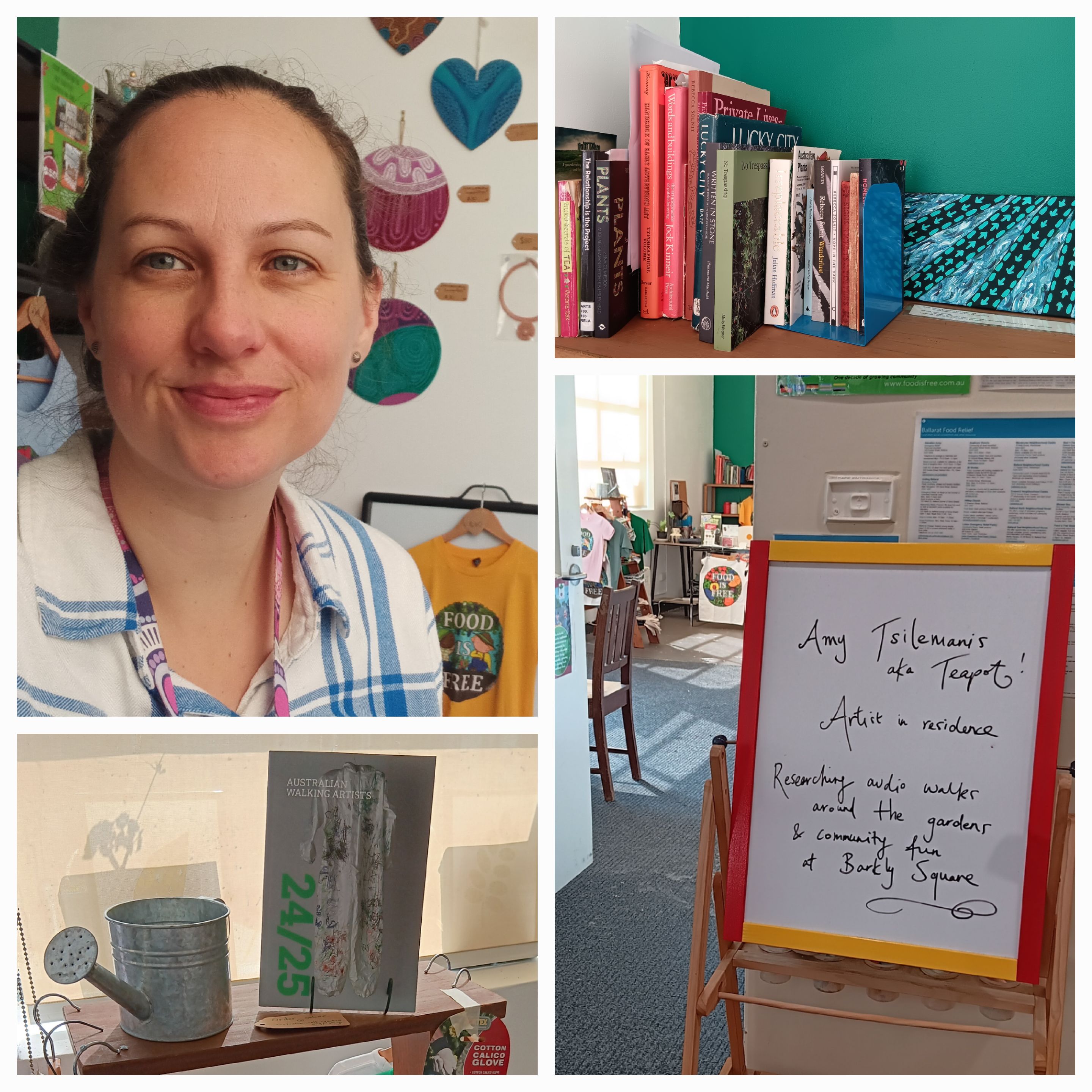
Then! a couple of months ago I also began volunteering with the legend Lou Ridsdale at Food is Free Inc and Barkly Square, Ballarat East and was invited to activate the outdoor entranceway to this historic community and cultural hub with teapots. I said yes please! And the rest is history. Everything will come together in this creative installation, being launched as part of a special Barkly Square celebration on Saturday Nov 15th (save the date!)


Me and tea : )

I grew up in a tea loving family, nothing fancy, but the simple appreciation of a cuppa in the morning or after work, and afternoon tea with visitors, maybe enjoying with some of mum’s chocolate cake. Somewhere around my teens I also got onto the relaxing herbals (tea and otherwise ; ) and still can’t go past a lovely hot chamomile. Tea has always been comforting but also aesthetic for me- choosing the cup, seeing the colours, arranging cosy chairs, delicious treats at hand. And I’ve always loved teapots for both their design and function. Here is a pic of me, aged maybe 15 being a silly teapot, and the other day ; )

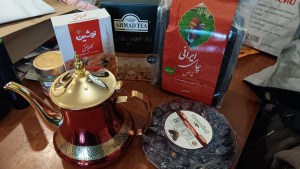
    

Fast-forward and my wedding vows featured tea of course, and the joy it brings in our daily life at home; different types for different moments in the day: earl grey, ceylon, orange pekoe, vanilla rooibos, genmaicha, Turkish apple, chai with soy and honey, peppermint, rose, and lemon balm from the garden, or trying new things (Julian just came home from a trip to multicultural Sunshine with some delicious Iranian tea and biscuits, and a new teapot! The kettle is on now to sample, mmmm).  Thank you Chinar International Food Market.

Sharing a cuppa- tea, coffee, whatever your pick- with different people, and across different cultures, or snatching a moment on your own is a chance to breathe, to taste, to converse, to look around and look within.

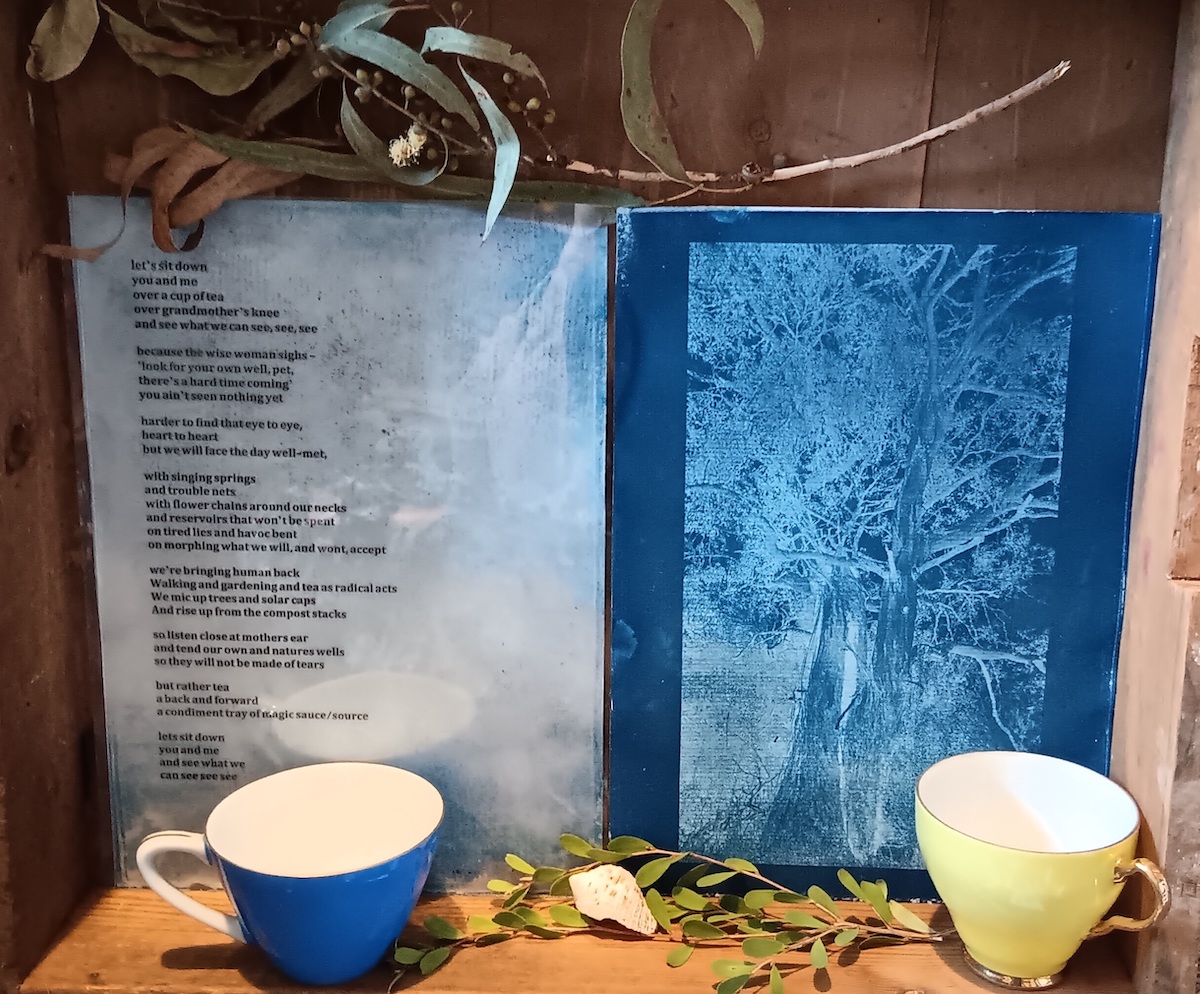
Working recently with traditional custodian Richard Collopy on the Manna Gum Stories project, he described the path he often walks (and ethos he takes) in First Nations education, as ‘the continuing cup of tea.’ Things are shared, shaken up, and importantly, they take the time and space they need. The idea of being able to sit down and talk together across different backgrounds and viewpoints seems vital, especially in these times, and who better to look to for inspiration and leadership in Australia than the world’s oldest living culture. I wrote this poem, inspired by my many, and ongoing, chats with Richard and in my worries and also hopes about what’s to come and how we can meet it.
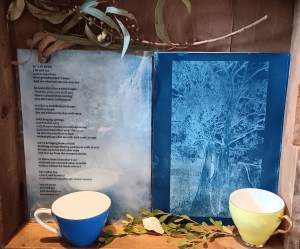
 

The Continuing Cup of Tea poem and cyanotype play
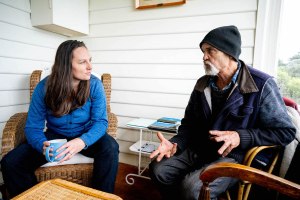
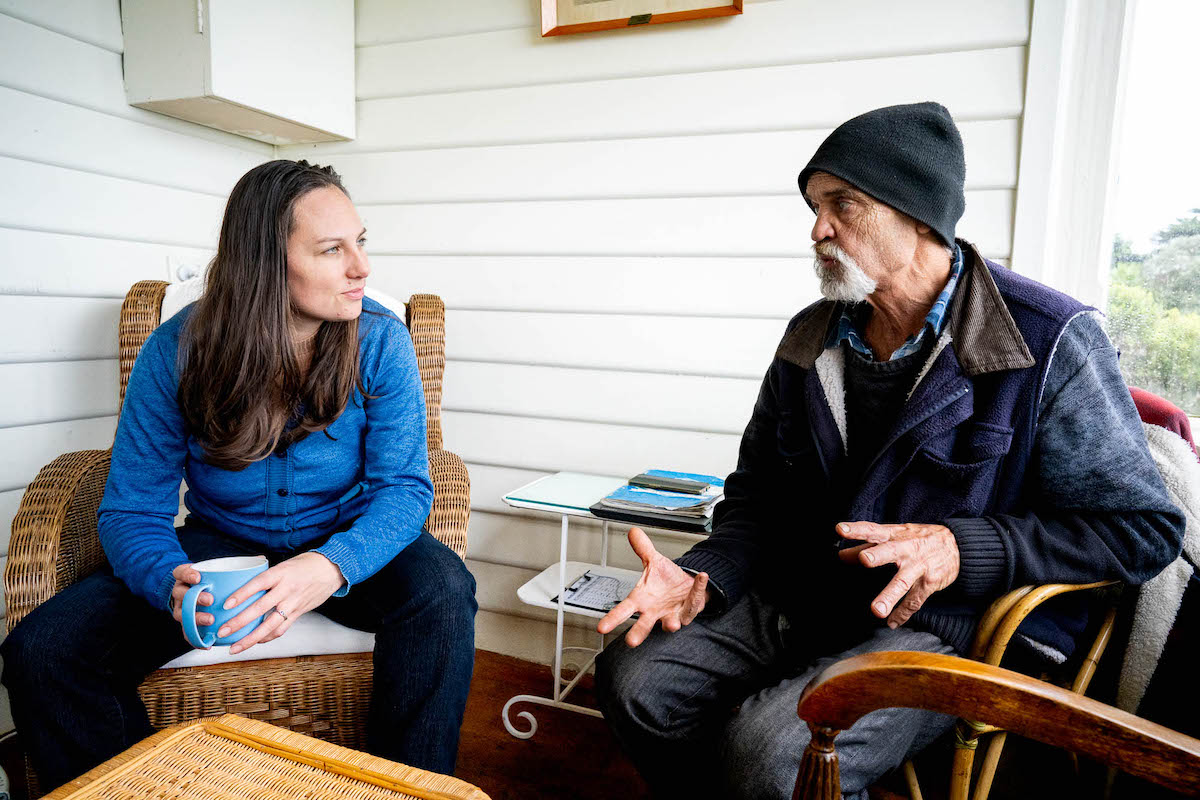
Amy Tsilemanis and Richard Collopy during the Heart Maps residency, 2023 (by Jade Forest)

Can a cup of tea save the world? Probably not, but it can make it a hell of a lot nicer.

Stay tuned my friends.


The continuing cup of tea (for Manna Gum Stories, April 2025)


let’s sit down

you and me

over a cup of tea

over grandmother’s knee

and see what we can see, see, see


because the wise woman sighs –

‘look for your own well, pet,

there’s a hard time coming’

you aint seen nothing yet


harder to find that eye to eye,

heart to heart

but we will face the day well-met,


with singing springs

and trouble nets

with flower chains around our necks

and reservoirs that won’t be spent

on tired lies and havoc bent

on morphing what we will, and won’t, accept


we’re bringing human back

walking and gardening and tea as radical acts

we mic up trees and solar caps

And rise up from the compost stacks


so listen close at mother’s ear

and tend our own and nature’s wells

so they will not be made of tears


but rather tea

a back and forward

a condiment tray of magic sauce/source


let’s sit down

you and me

and see what we

can see see see


The Magic Study of Objects

By Arts, Curation

Greetings from our cosy Winter loungeroom with snoring kitties, books, and Julian playing sweet guitar. As the broader world continues to be a confounding and heartbeaking place and we are all doing what we can in our own ways, I wanted to share some small joys, sent with love and thanks to all the good people making their way. Settle in for a wander/wonder.

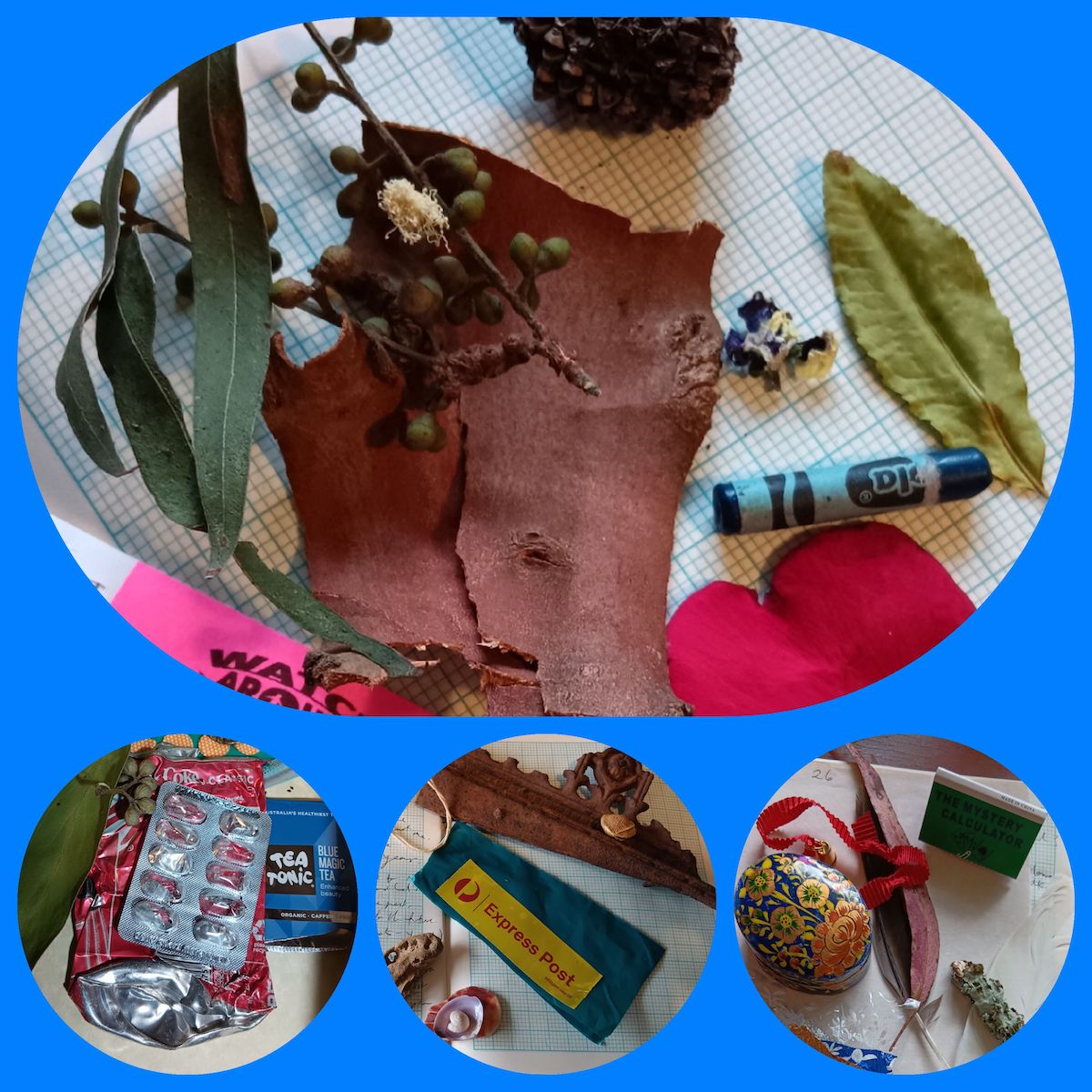
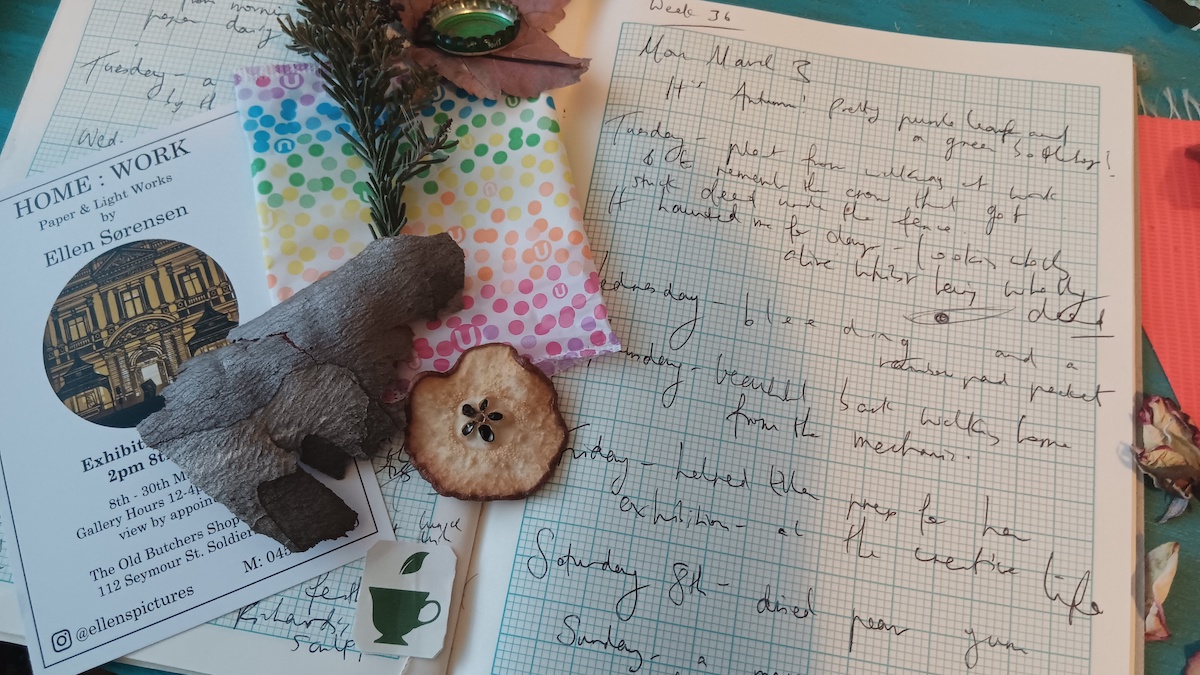
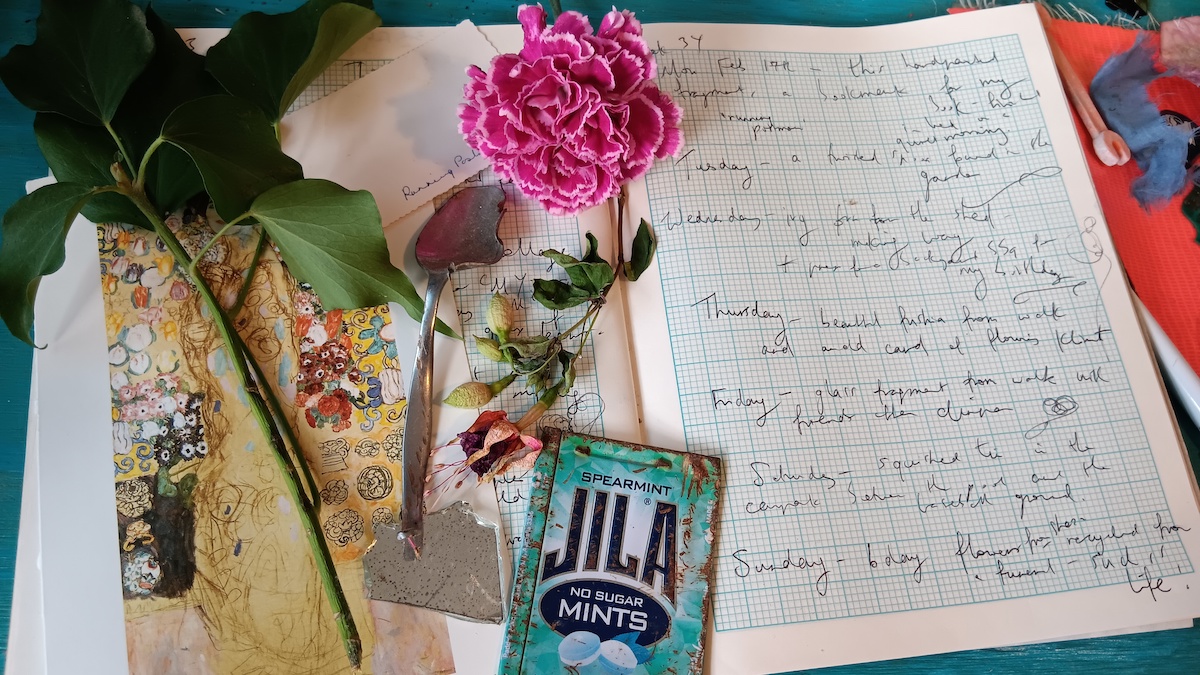
On Tuesday it marked one year since I started my daily collecting project, now known as the Bowerbird Project, and I have now completed all 52 weeks! See week 1 and 52 here with me pottering in the collagarium/collectorium : )

This week is also two years since I first visited Northern Greece and connected with my ancestry in the region along with an international world of walking artists.

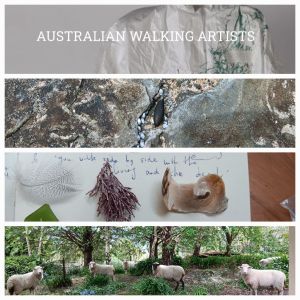
My love goes out to fellow Australian Walking Artists co-convenor Molly Wagner and all the curious folks wandering in Prespa this week for the 2025 Walking Arts Encounters and the opportunity this network provides to merge individual and collective practices towards peace and connectivity across artforms, and borders of all kinds. There are also so many wonderful things happening all around Australia with AWA artists and beyond, and as always we are listening and learning, wondering and wandering. If you’re interested in joining- check us out here and help us build this network of kind and curious creativity.

Some Bowerbird images and reflections follow here along with some related museum adventures from recent travels. So why did I start this project?

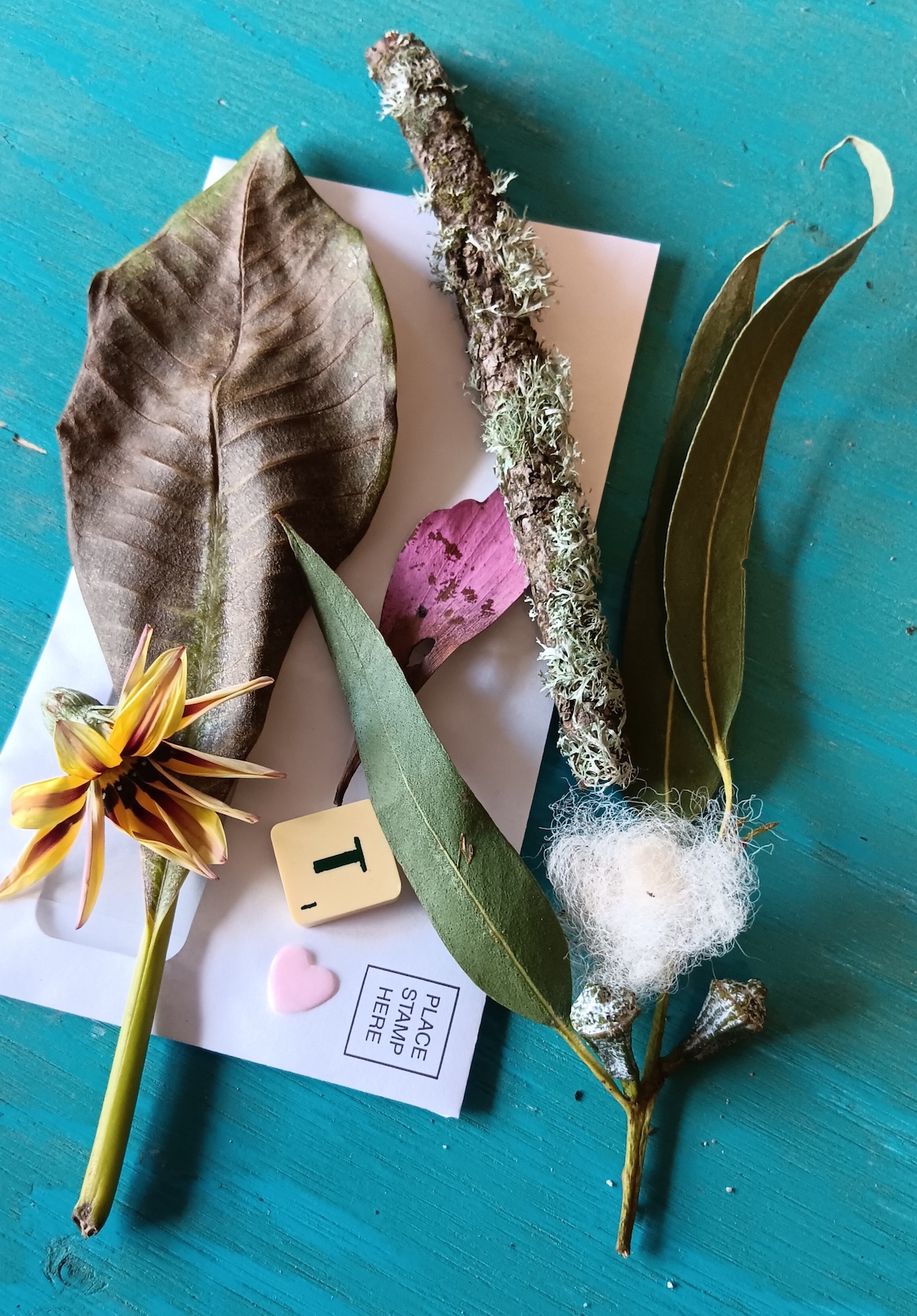
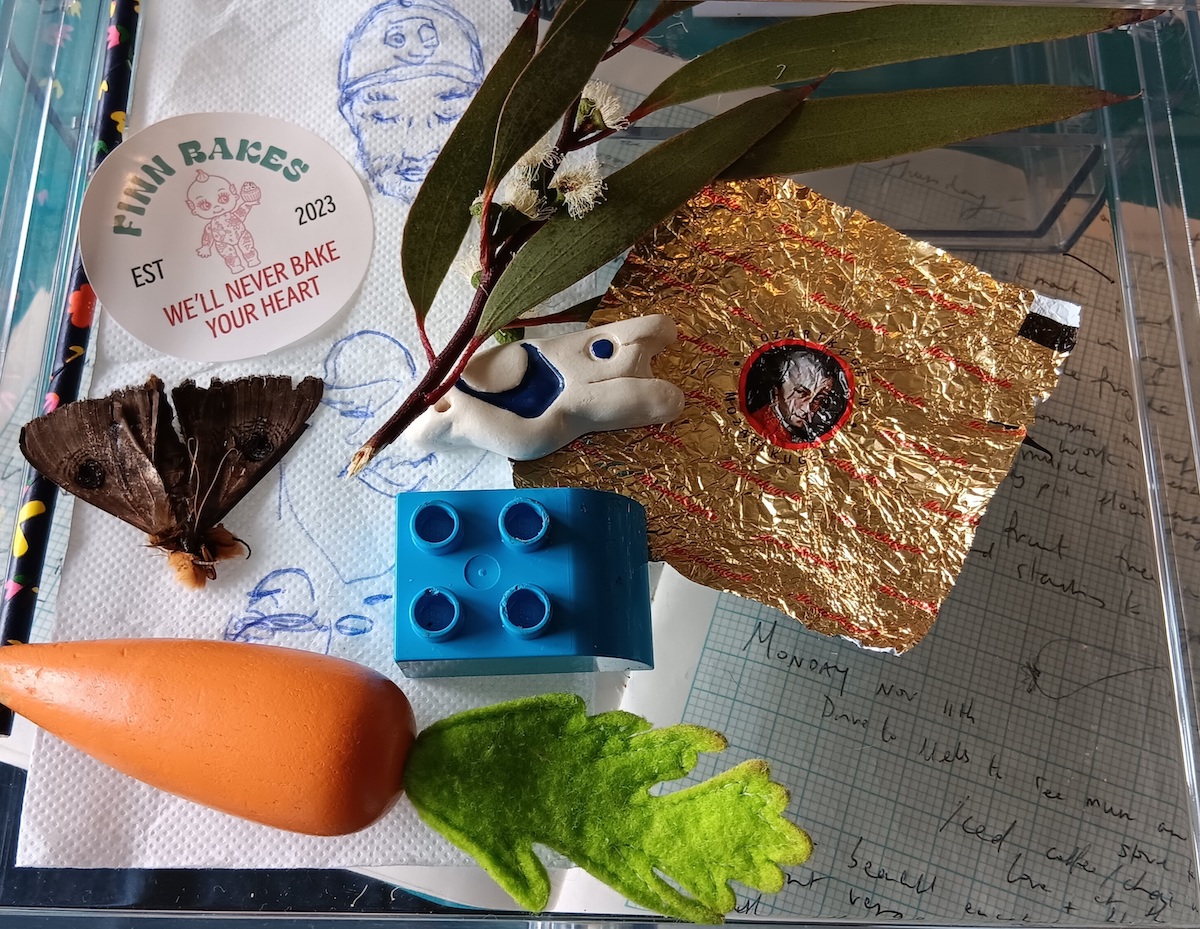
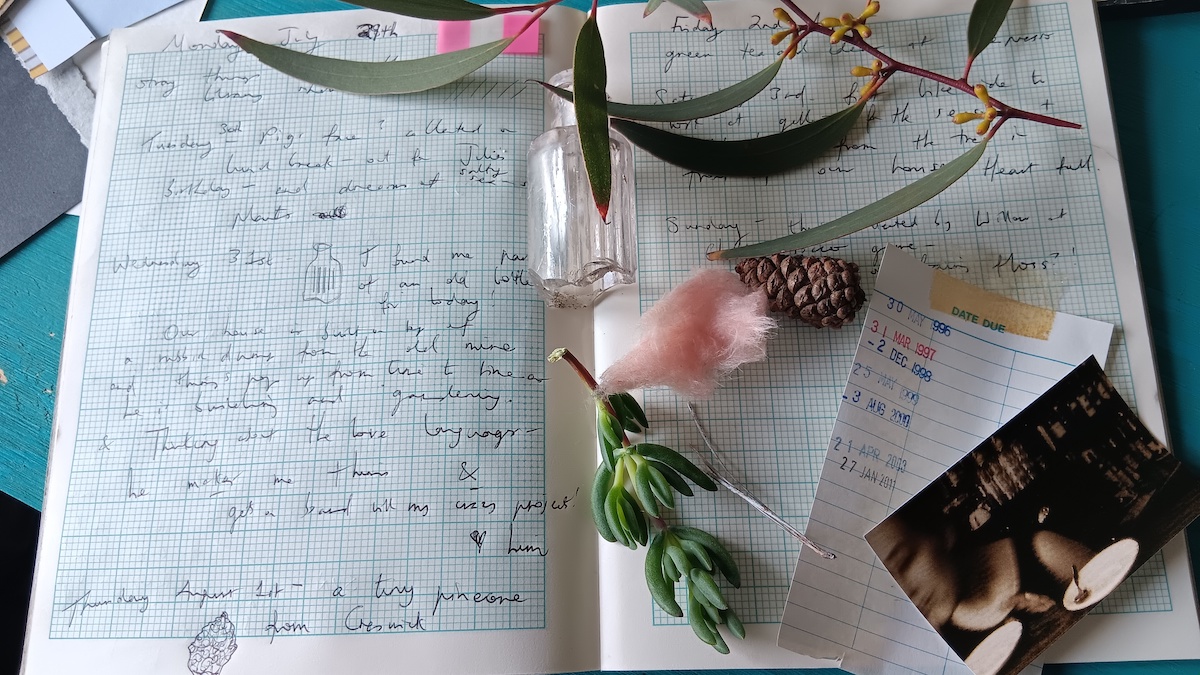
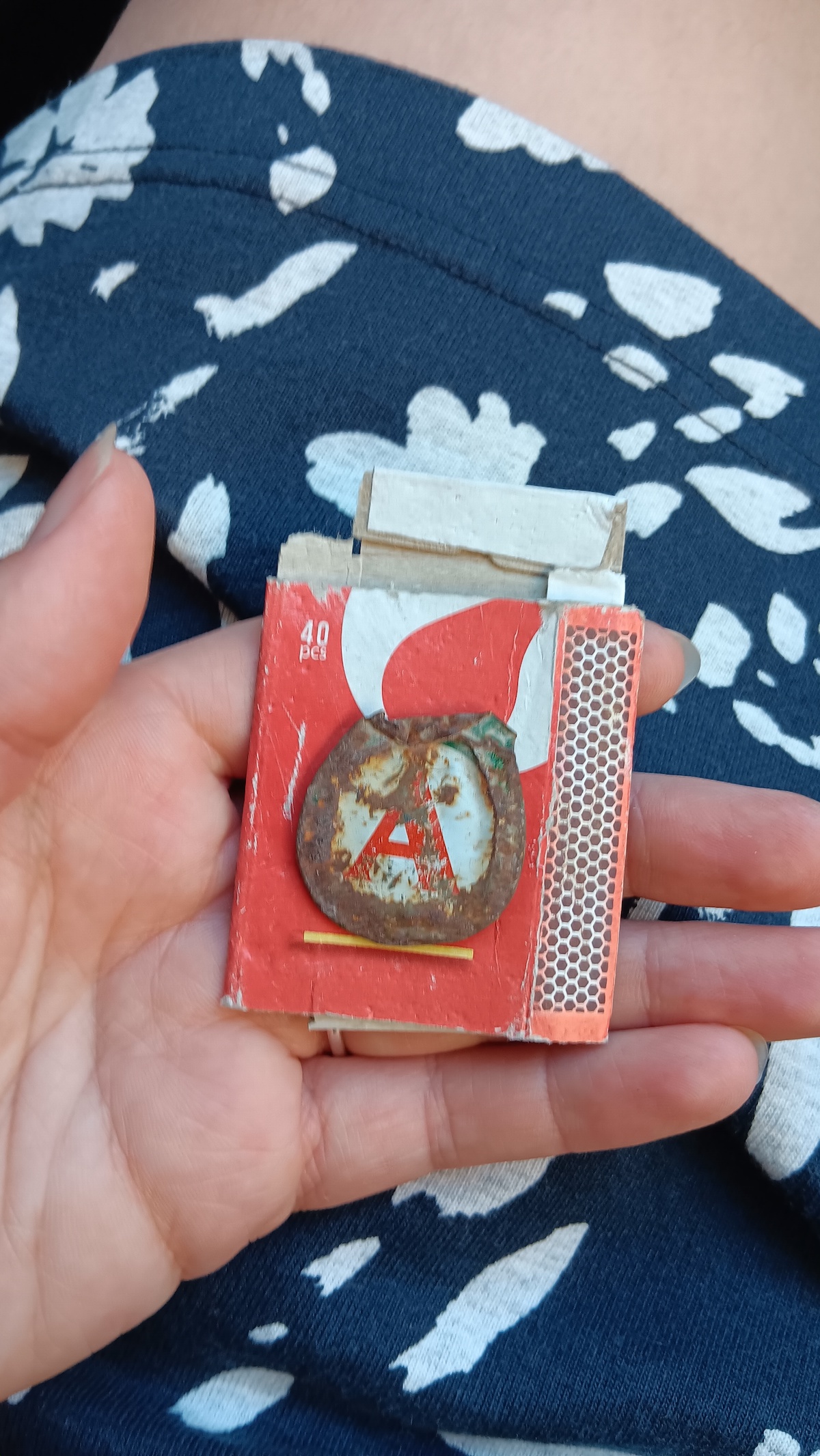
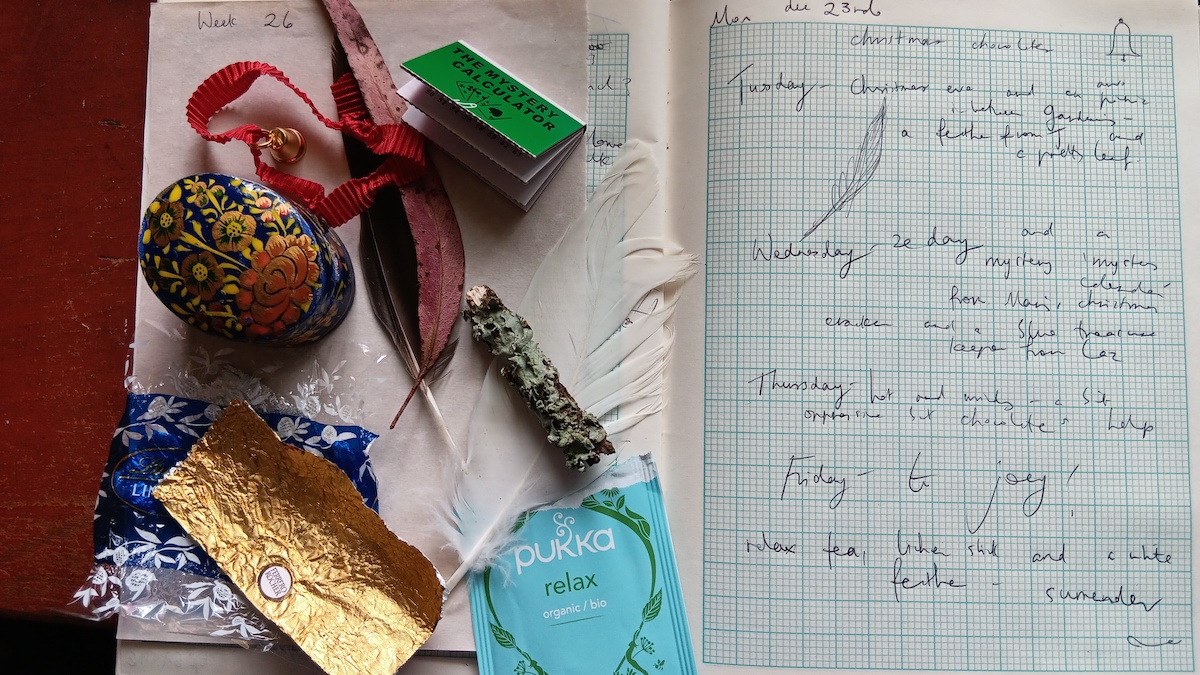
In feeling overwhelmed by the problems of the world and ‘the big picture’ I went in small, without any preconceived or grand ideas. When someone asked me the other day what my criteria was for collecting, I reflected it was basically anything that drew my attention, not too big, and no bad smells ; ) Essentially ‘No criteria’ but it evolved into a way of noticing and appreciating the everyday, and indulging my love of collage and assemblage.

I chose to send an image of the week each Sunday to a local artist friend and she had this to say:

“Amy’s collection has been a highlight each week. Seeing what someone observes and collects, versus what I have often taken for granted, walked over or not even seen, has been fascinating. I now look for treasures. It started with me thinking “Amy would love that” to now realising that I now look to seek the beauty in the everyday. I hope that this project is seen far and wide to remind us of the world we navigate.”   

Thanks Lauren Mathews! 

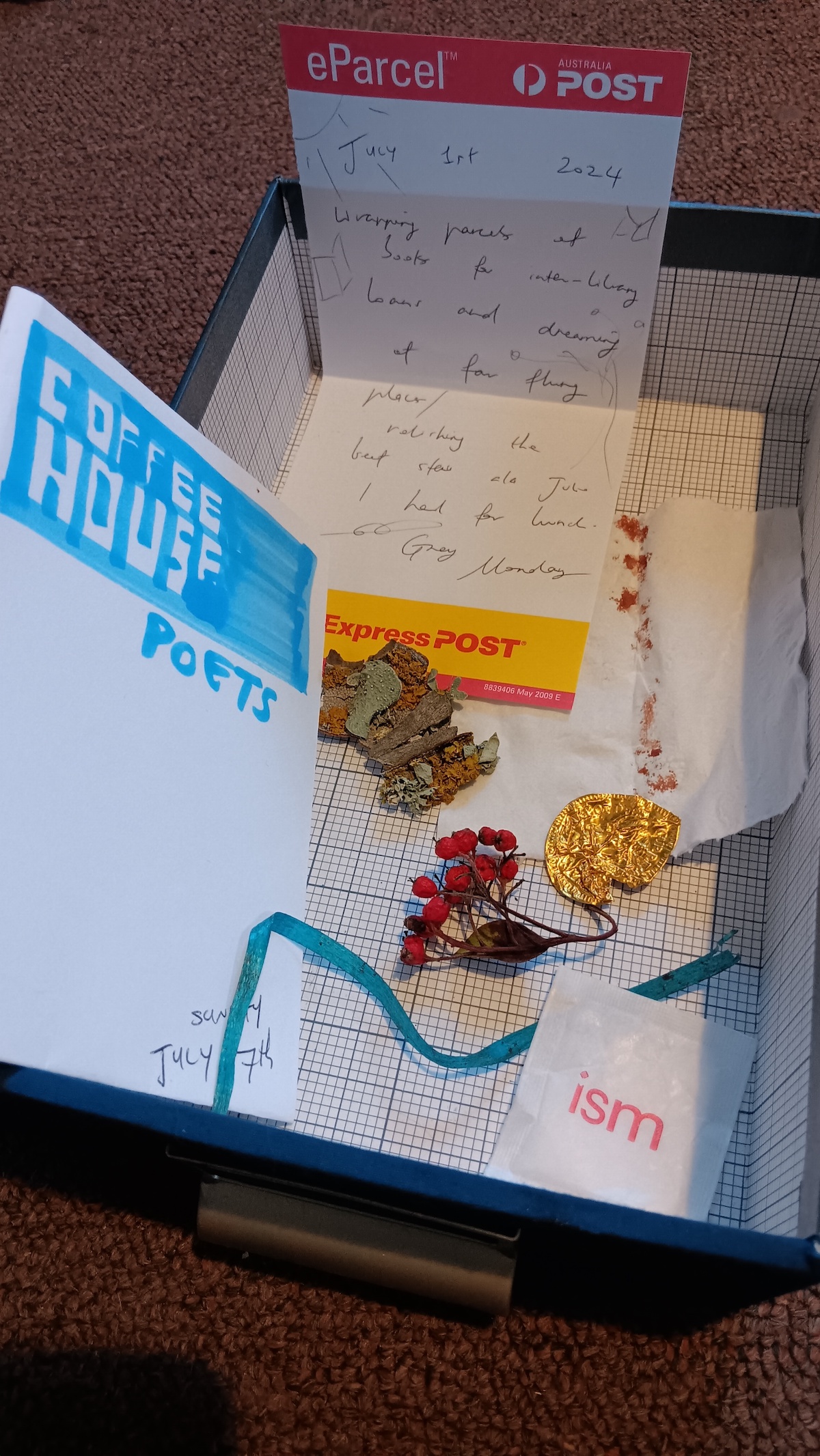
I photographed the objects weekly- again nothing fancy- accompanied by their short daily diary entry, and will see which artforms the project takes me towards next: possibly bookish, aural, sculptural, possibly participatory, so stay tuned, and for now I hope you enjoy these ponderings and pics.
Looking over the weekly photos this week, I jotted down some of the items- leaves, teabags, pills, pegs, rocks, fabric, blood, moths and pinecones; a mix of aesthetics, patterns, meanings, curiosities, records, frustrations, joys, woven through walks, threads, layers, perspectives, seasons of life, seasons of the world, navigations through…

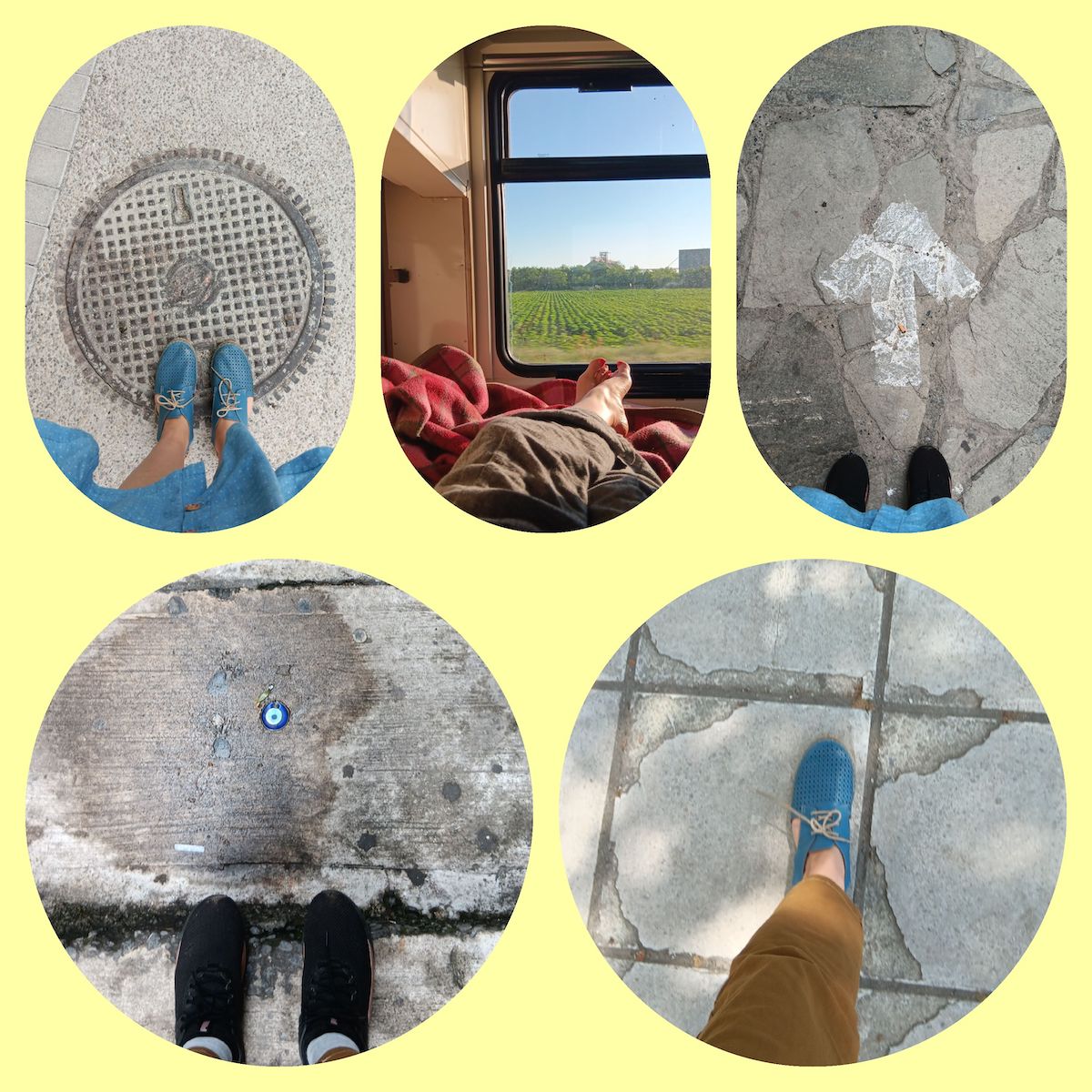
Sometimes objects and collections related to a particular walk and these swelled a bit during recent overseas travels (the 20th edition of A & J!) I made these collages with the objects and photos from the walks- the people & places and noticings- and playing with the idea of the xray, the close inspection of the not-obviously-interesting, the little beauties. And some more of the weeks for you to explore below.

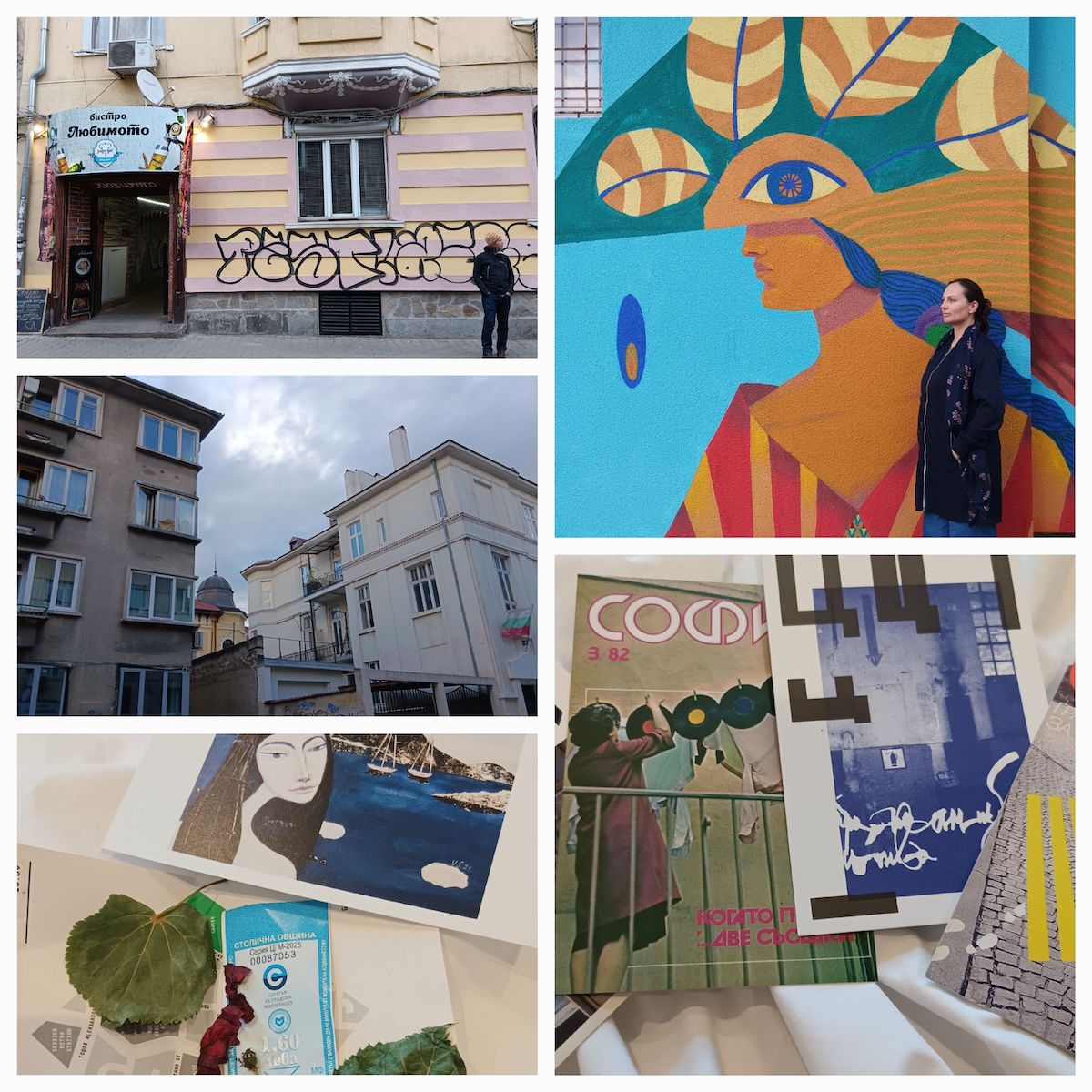
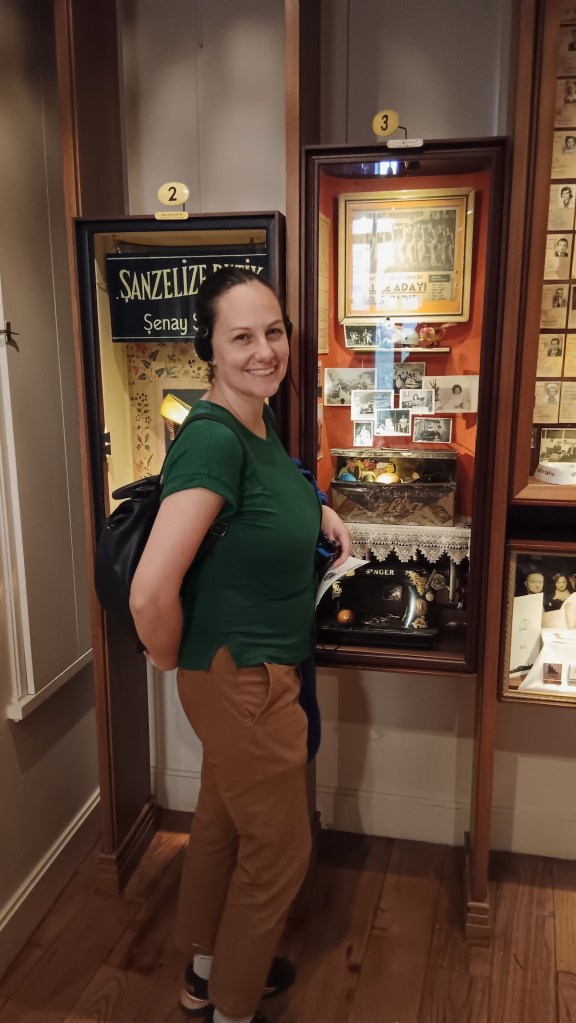
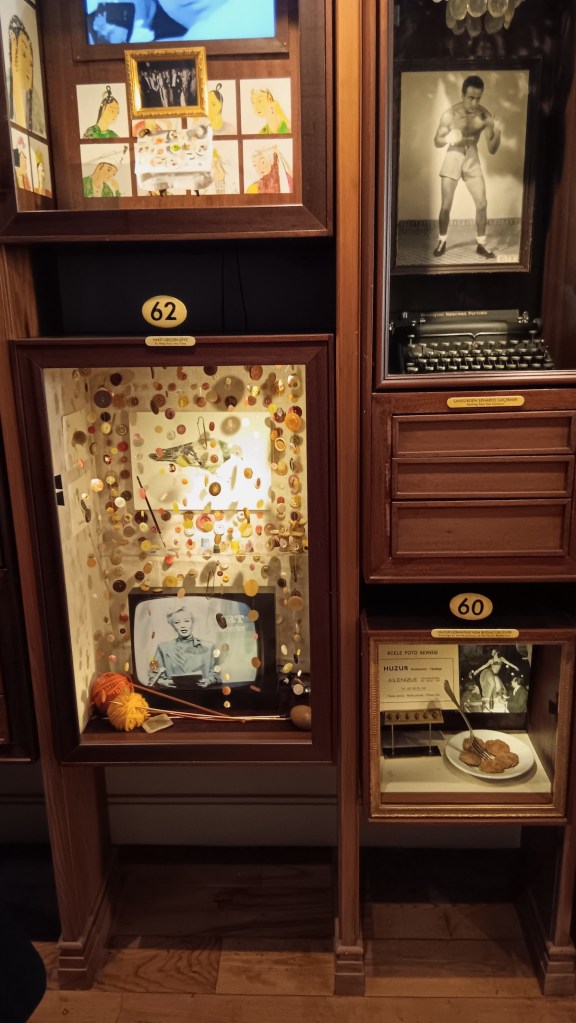
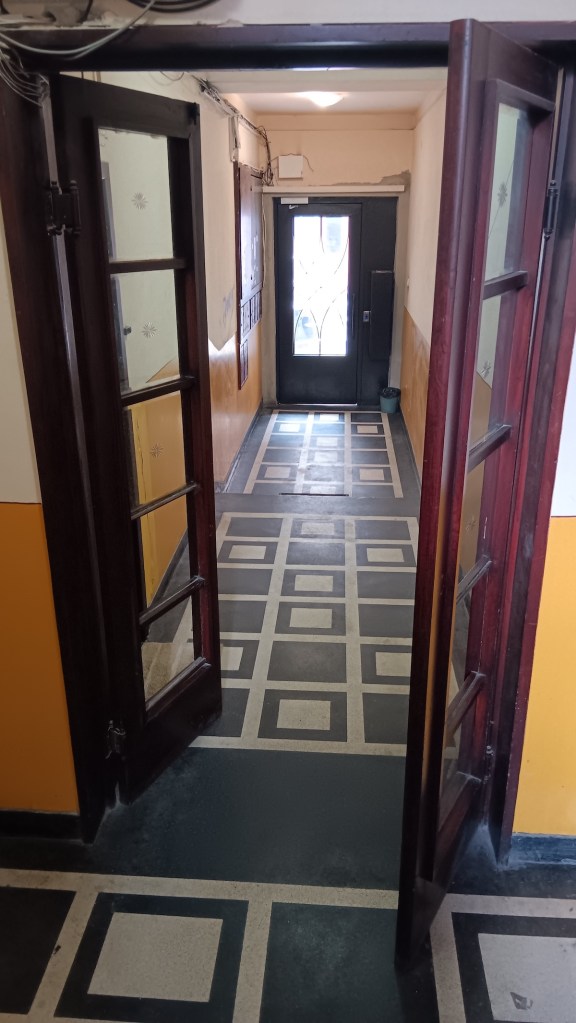
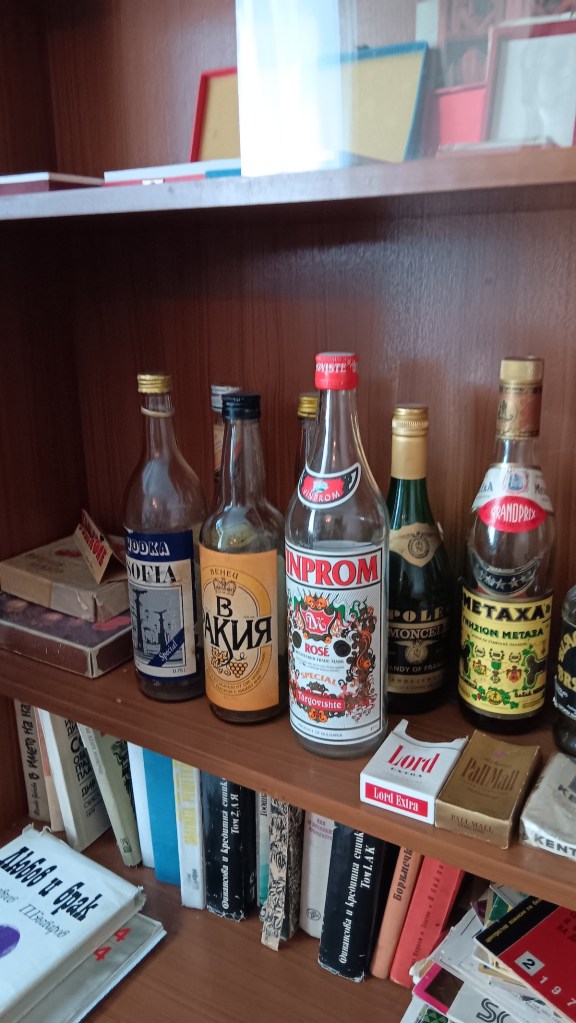
On our travels we were lucky to visit some unique museums that used everyday objects in powerful ways: The Museum of Innocence in Istanbul, Turkiye; The Red Flat Museum in Sofia, Bulgaria; the Polycentric Museum of Aigai, in Vergina, Greece; and the NSDoku- Munich Documentation Centre for the History of National Socialism, Germany.

The four museums allowed us to journey through 1970s Istanbul, 1980s Bulgaria, 4th century BC Macedonia and 1920s-40s Germany. A brief summary here but deeper thoughts to follow!

I was in heaven in the writer Orhan Pamuk’s Museum of Innocence, fortuitously stumbled upon by a visit to a ferry-side bookshop and fit into the last hour before we boarded the overnight train to Bulgaria! This museum revolves around an imagined life and also a novel, a fictional story meticulously brought to life through collected and displayed objects. I loved it so much, and as Pamuk discusses himself the museum explores how objects can turn time into physical space.

After being immersed in this fictional world and Pamuk’s writing on creating the book, museum and an associated film, it was interesting to experience the Red Flat Museum only a few days later, a time-capsule of life in 1980s Communist Bulgaria. The museum is located in the apartment of the family that used to live there, ‘interactive’ in that you are invited to touch the objects. I did this with both pleasure and awkwardness. Note there were no interactive smells.

Then to Northern Greece and for something completely different!- the ancient kingdom of Macedonia and its remnant palaces, tombs and the relatively new ‘Polycentric Museum.’ After the overwhelming royal riches in display case after display case- of statuary, jewellery, gold leafed crowns, and weapons in the tomb museum, I was very taken with the display of these collections of like-objects from everyday life: of keys, nails, tools, roof tiles complete with fingerprints- human and animal; the human scale.  As one museum tour guide has described it “the reality of life.”


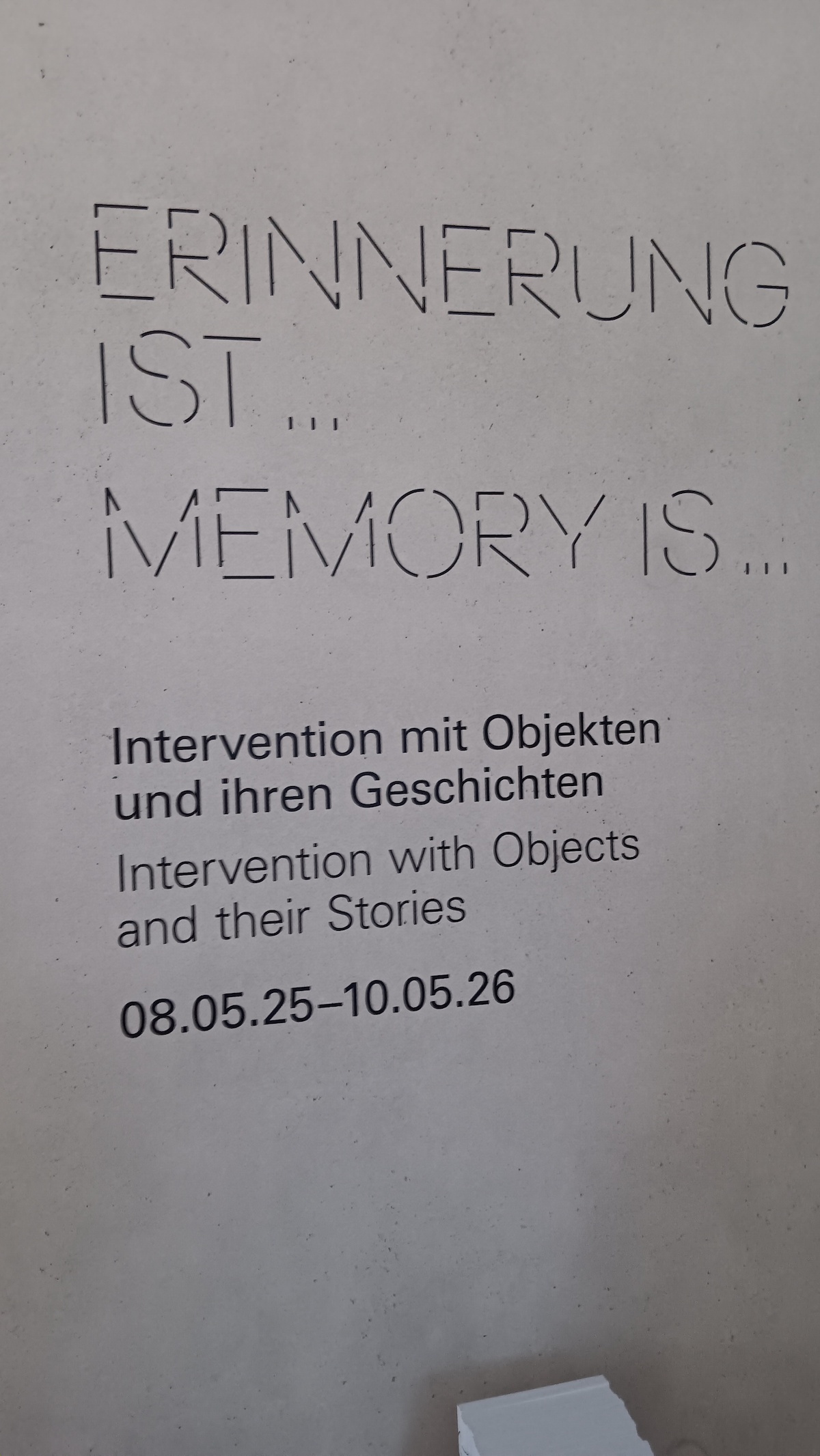
In a similar, but more personalised and heartwrenching manner,  the exhibition ‘Memory Is’ at the NS Document Museum dispersed 22 items throughout the multi-level history of national socialism and its horrors.“On nsdoku‘s tenth anniversary Memory is … invites visitors to reflect collectively on our relationship to the past: How do we remember? What do we remember? And how can painful and distressing experiences be portrayed and communicated today?”


Again the personal nature of the objects was key: A plate owned by a kindergarten teacher who was later killed along with many of her pupils; a puppet made by an amazing artist, also gone too soon, obliterated by fascist rule. It was impossible not to draw the parallel to the horrors happening in Gaza as people are once again dehumanised; their humanity, property, lives and futures taken. Let’s not turn our eyes away. And always keep in mind the human scale.

And so in these times, I send my love to you. And share my noticing of the small, the tangible, the everyday, the mattering of matter? And ongoing questions around which objects are sacred, to be handled, not to be handled, and all the stories they tell. And perhaps something about how museums in different ways can make us think about creativity and existence over destruction and death, both in the past and the present. It can be hard to know what to do when such horror (and global complicity) continues to unfold daily. It’s good to remember that our resistance and our advocacy can come in many forms and that small actions and noticing have their own value and magic.

Thank you for reading! And stay tuned on the Bowerbird Project as it evolves into its next phase.

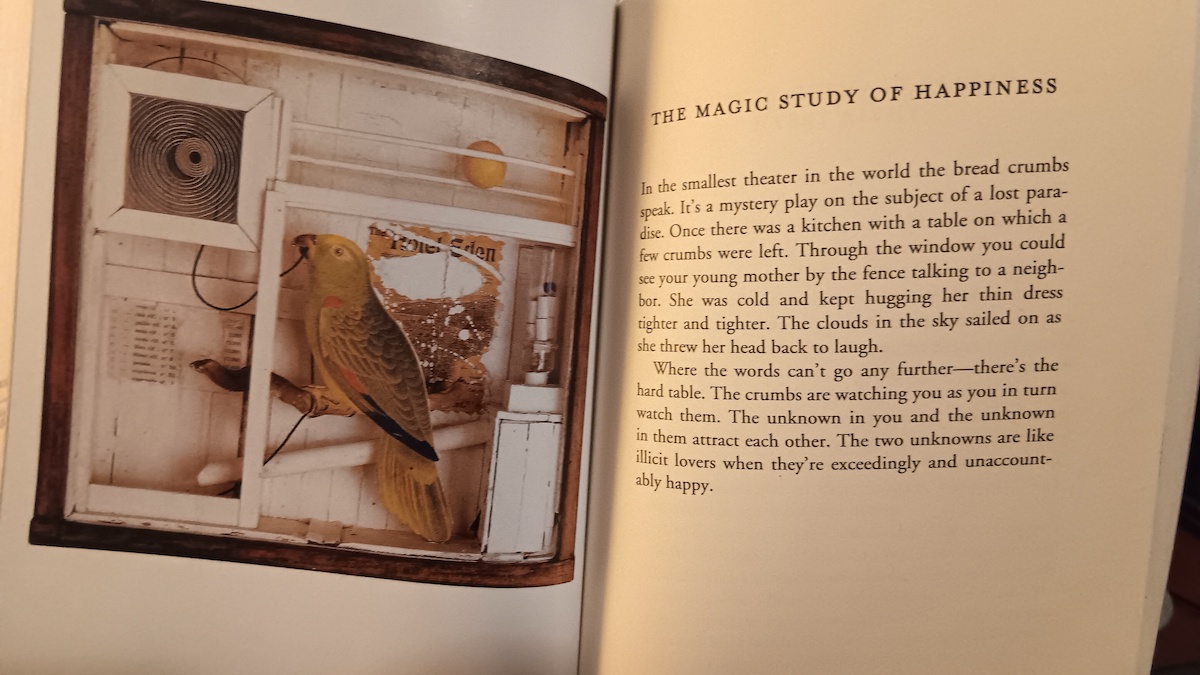
I will leave you with Joseph Cornell and Charles Simic (from Dime Store Alchemy) and the ‘smallest theatre in the world’….

PS: We also loved the Museum of Greek Folk Musical Instruments in Athens– highly recommended! Each of the instrument/objects is accompanied by songs played with these instruments and it was amazing to be taken through so much history and culture through music. I was so happy.

Sending pockets of happiness and inspiration to you all x


MANNA GUM STORYTELLING FUN!

By Arts, Curation

We’ve made a website, we’ve made a book, we’ve made short films, we’ve almost made an exhibition….  ahhhh the joy!

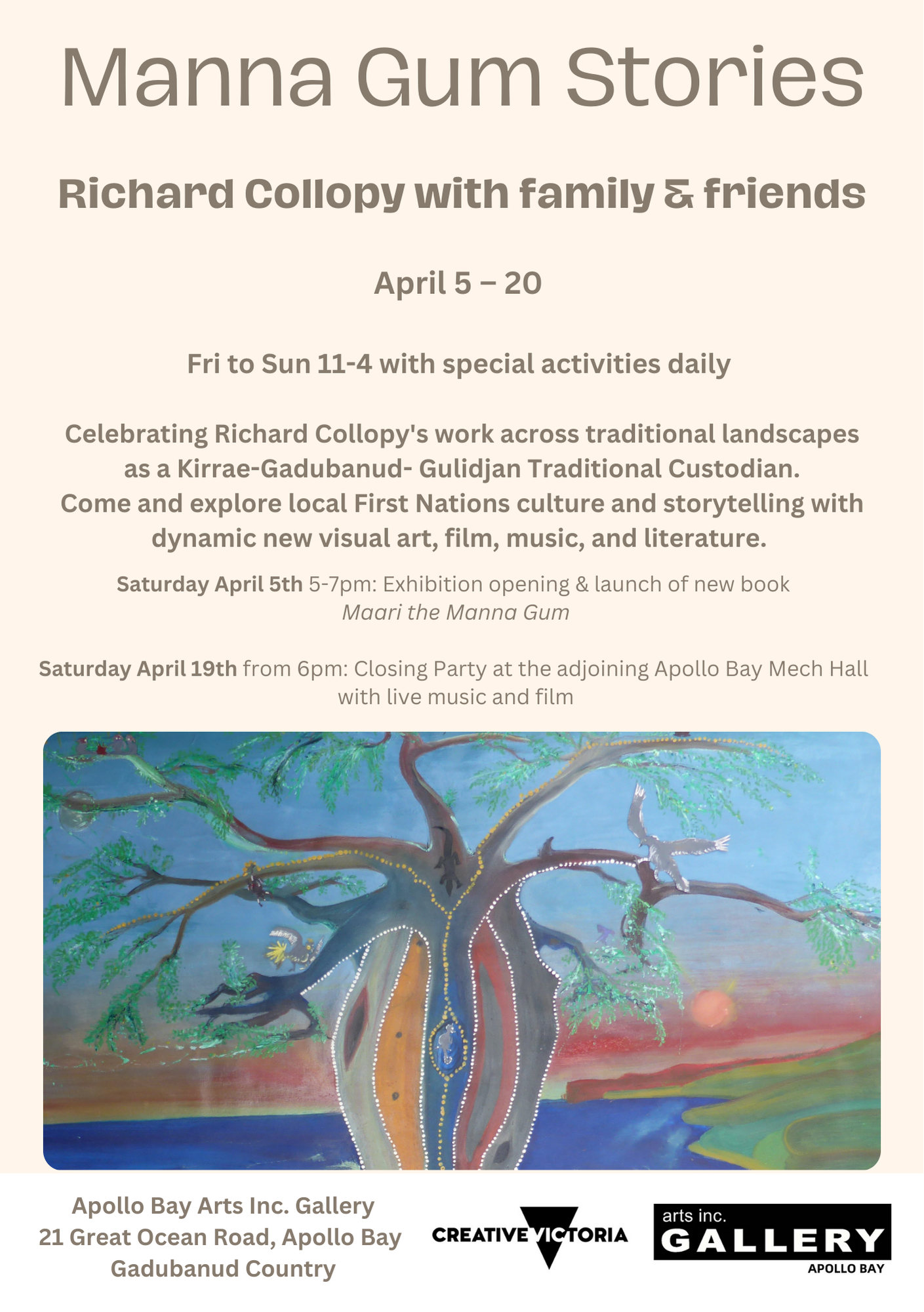
Come and celebrate the opening of Manna Gum Stories next weekend in Apollo Bay, Gadubanud Country and until April 20th

All the info below : )

.      

Richard and Amy with his Maari the Manna Gum painting

Julian with first look at the book he designed, looking fab!


A Bowerbird Year

By Arts, Curation, Walking Arts

Hello my friends,

It’s that time of year, and I’d love to share a few things to explore at your leisure!

woman colourfully dressed holding flowers and moss standing in suburban street with spring blossom on trees

Amy walking and collecting in Ballarat East, Wadawurrung Country

This year, in amongst it all, I have been continuing to help build the national collective of kindred spirits that is the Australian Walking Artists (AWA). In our first year we have nurtured an online community with a monthly newsletter and catch ups with guest artist presentations and chats, and I love running the Instagram account and seeing all the amazing things people are up to at home and abroad, and all the connections and collaborations being born. In our first year, AWA has held its first exhibition, an artist retreat, and we have our very own book awaiting publication! Explore it all here

The next step is getting legit with organisational incorporation so that we can do more things. Stay tuned. And as always, we practice deep listening and learning as artists walking on stolen land.

As our friend Geert from Walk Listen Create writes on walking art in the 21st century:

“Today, the art of walking functions not only as a subject and practice but also as a tool for healing, fostering social change, and strengthening natural ecosystems.”

Check out the call out for next year’s Walking Art Encounters in Prespa Greece and also keep an eye out for plans hatching for a parallel happening in Australia.

In the meantime if you need to float away on waters and poetry of Northern Greece for a moment watch this we made there last year : )


My ongoing collaborative work with traditional owner Richard Collopy continues with producing the exciting Manna Gum Stories project. We’ve been working on Richard’s new website, a children’s book and digital stories that will all be launched at an exhibition in April next year at Apollo Bay Arts Inc. It is an honour to be part of bringing Gadubanud culture to the world, and advocating where I can on complex issues along the way.

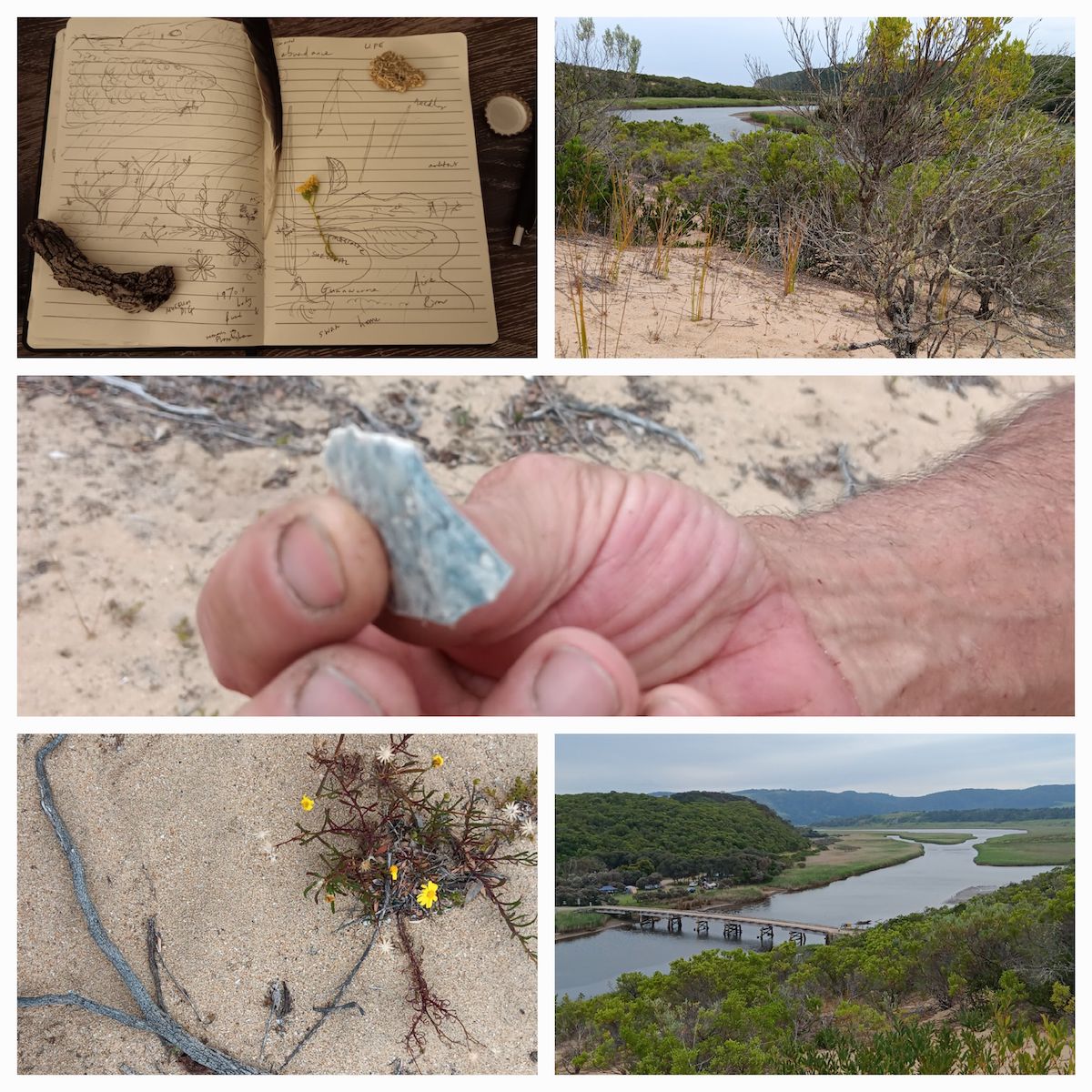
photo collage with 5 images showing notebook, scenes of sand and river, plants and a hand holding a shard of rock

Walking with Richard at Aire River


In my own creative work, I have been enjoying some low key creations, no hustle to produce, that connect to walking and noticing: recording audio chats with good humans (and a failed grant app for a cool collaborative podcast that could still become something!); making terrariums, tiny glass worlds of moss, rocks, mushrooms, treasures; having fun with photo collages from my wanders in city and country, melding colours, textures, tones. The below feature walks in Melbourne, Brisbane, Apollo Bay and Ballarat.

And I am doing a fun thing loosely called The Bowerbird Project where I collect something every day for a year and record a short journal entry from which I will create a kind of 3D collage of some sort at the end. I am enjoying exploratory things without set outcomes or expectations and learning as I go.

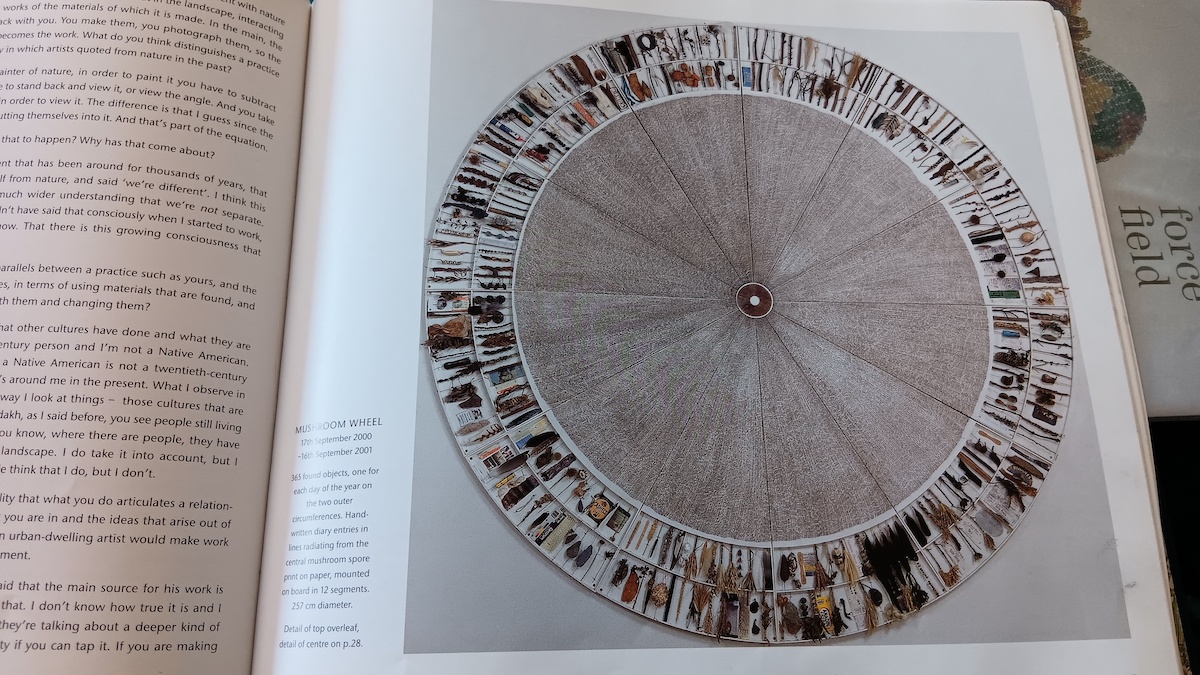
This idea of collecting and journaling over 365 days was inspired by Chris Drury’s 2001 work Mushroom Wheel: a mixed media work featuring 365 found objects one for each day of the year and hand written diary entries in radiating lines from a central mushroom spore.  (Pictured here in the book Song of the Earth).

image of artwork in a book

Chris Dury work Mushroom Wheel 2001

I love seeing other variations on this idea like the wonderful Vanessa Berry (fellow AWAer) and her book coming out next year titled Calendar where Vanessa saysI focus on everyday, retro, and memory objects, a year’s worth of interesting things, and I look forward to sharing it with you next year.”

I have also loved discovering artists like Rosalie Gascoigne and her great reminder that while we gather inspiration from around us and from each other, all creative expression is unique to the point that each person is unique. With respect, we can acknowledge these things whilst creating something new, from our own singular perspectives and in our own unique forms.

“You need never dry up, you need never dwindle, because life gives you some sort of adventure, happy or sad, all the time. That is what you have to plug into, the region where you live, and what you really know is in your bone marrow.” R.G

a photo collage with 6 images including books and cat and sunlight playing over

Photo collage with Minerva and Rosalie


Happy resting, reading and keeping up the good fight for peace and humanity. Watch the awesome Nan Goldin advocate for Palestine at her recent exhibition opening here.

& to close here are some books I read this year that you might like too:

Fiction

All Fours by Miranda July

Olive by Emma Gannon

The Bell of the World by Gregory Day

A Land of Stone and Thyme, an Anthology of Palestinian Short Stories eds Nur and Abdel Wahab Elmessiri

Sunbathing by Isobel Beech


Non-Fiction

Memory in Place: Locating Colonial Histories and Commemoration eds Cameo Dalley and Ashley Barnwell

Janet Lawrence, The Pharmacy of Plants by Prudence Gibson

Song of the Earth: European Artists and the Landscape by Mel Gooding

Gathering Moss by Robin Wall Kimmerer

Erosion, Essays of Undoing by Terry Tempest Williams

Flaneuse: Women Walk the City in Paris, New York, Tokyo, Venice and London by Lauren Elkin

Motherlands: In Search of our Inherited Cities by Amaryllis Gacioppo

Wanderlust: a History of Walking by Rebecca Solnit

Glass after Glass by Barbara Blackman

We are the stars by Gina Chick

Things that Helped, Essays by Jessica Freidman

The Story of Art Without Men by Katy Hessel

Position Doubtful by Kim Mahood

Comparative Monument (Ma’man Allah) by Tom Nicholson

To the Lake: a Balkan Journey of War and Peace by Kapka Kassabova

Rosalie Gascoigne by Kelly Gellatly (NGV)

Florine Stetheimer by Henry McBride (MoMA)

Fiona Hall, Force Field (MoCA)

Dime Store Alchemy: The Art of Joseph Cornell by Charles Simic


See you in the new year!

x

Heart Mapping in the Otways

By Arts, Audio, Curation, Heart Maps, Heritage

It’s been a while! After years of being unsuccessful with the elusive State Library of Victoria Creative Fellowship program I am happy to say that I am deep within my very own Regional Arts Australia fellowship project as we speak. It’s called Heart Maps and it’s based in the beautiful Otways on Gadubanud Country: 6 months connecting with and researching the different layers of the region through people, place and collections, and working towards the creation of a new audio theatre work, woohoo!

I am feeling so honoured to bring together a crack team- Traditional Owner Richard Collopy as cultural advisor and collaborator (see below for my story about him in The Otway Light), Apollo Bay arts legend Jade Forest, musician and producer Aimee Chapman, and the Apollo Bay Museum crew where I will be capturing oral histories, plus of course all the locals who get involved with the project.

I’m running some workshops this weekend at the cool Project Space in Apollo Bay and still have some spots left if anyone would like to join!

Book here

Heart Maps project logo and info Workshop Info

And learn more about the awesome work of Richard Collopy below:

The Talking Hut at Cape Otway Light Station (published in Issue 16 The Otway Light 03/06/22)

With Amy Tsilemanis

 “In the aboriginal worldview, everything is living. So everything is a manifestation of some other living part. And, of course, with objects that are made, then they’re made by somebody and invested from the person who’s making it and everyone who came before, like the ancestors…So what you make, why you make it, when you make it, is all part of this ancestral cycle of life.” –Margo Neale in First Knowledges ‘Design: Building on Country.’

I arrive through the paths of coastal ti-tree at the hut, alone but for a light rain and the birds. The hut is circular, hand-made with local materials and strangely welcoming amidst its empty, abandoned air. It has no doors, no locks, artefact cases holding only labels, and covered in a layer of disuse. One case reveals a message (a plea?) written with a fingertip through the dust: ‘Please re-open the Talking Hut. We need these spaces.’ I walk past the grime covered information sheets ‘Aboriginal Ground Edge Axes,’ ‘Aboriginal Coastal Shell Middens,’ a broken chair, a fire extinguisher, a Covid sign attached to a branch with a cable tie, greenery coming in through the round, open windows sculpted out of the hut itself, a place to sit half inside half outside. I see the old information board shoved into a makeshift cupboard that states ‘The shells are fragile, the story is precious.’ Empty as the hut appears, I know that there is life here yet. Like Margo Neale’s words above, life has been transferred into the walls, the spiral roof, and the walking track outside. This Talking Hut still has more to hear, more to say.
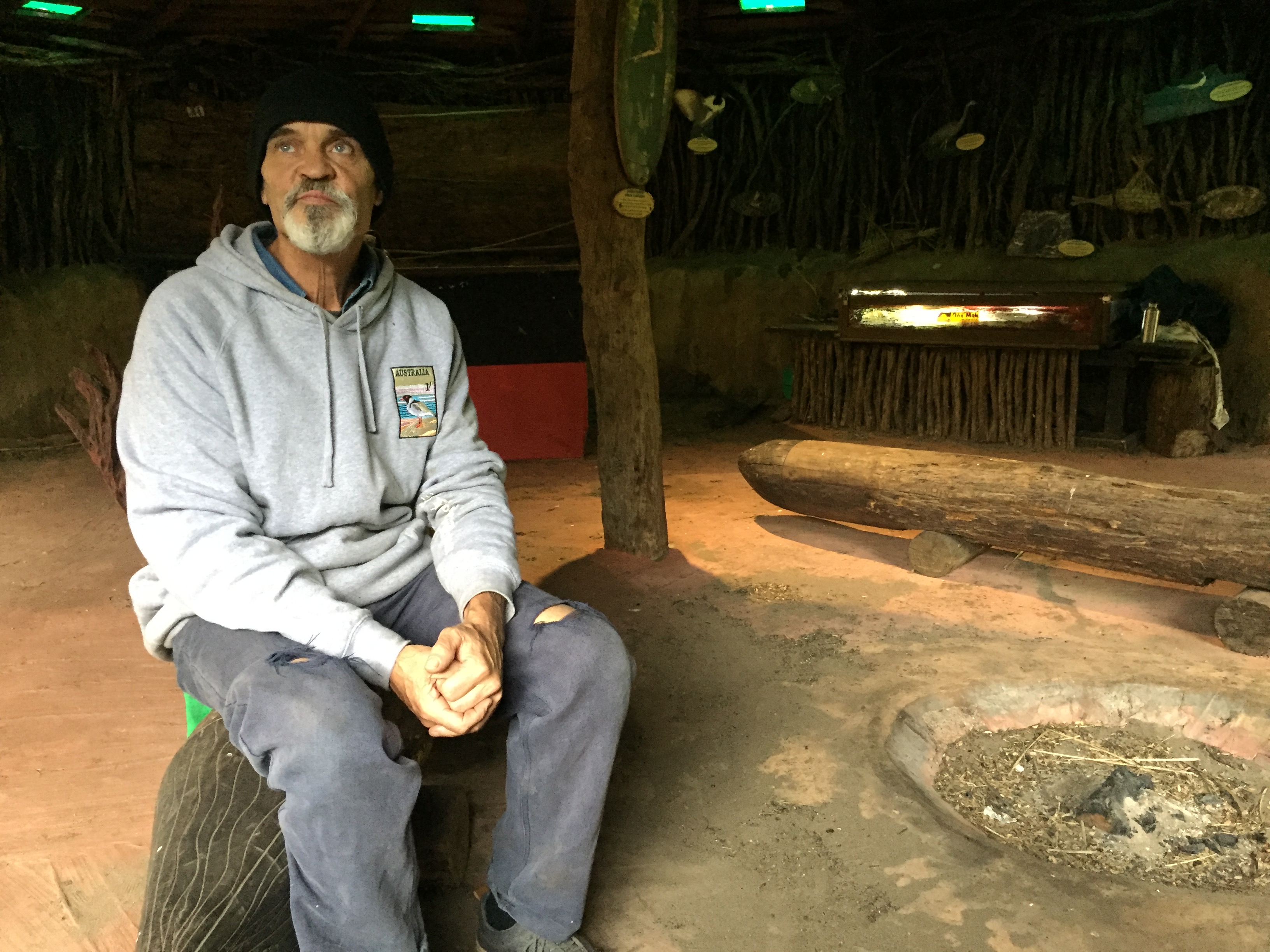
Today I am lucky to be meeting with the artist and builder behind this special place, Richard Collopy and family. They are Traditional Custodians, and when they arrive they show me a map on the wall of Victoria’s almost forty Indigenous language groups, explaining how Victoria is language rich due to the fertile land. They point out the southern Gunditj (groups) of the Otways area, all surviving.

Richard Collopy

Gadubanud Traditional Owner Richard Collopy inside The Talking Hut.  Cape Otway, 2022

We sit on the carved wooden seats around the fire pit. As we talk, the rainfall deepens. Despite the lack of a fire, there’s a sense of cosiness, of hearth, though also of something once lively, sleeping and dusted with days untouched, waiting for its moment to return. As Richard says, it is culture waiting to be reinvigorated. The hut has been closed since Covid disruptions at the Cape Otway Light Station and the Collopy’s are hopeful for a renewed relationship with the site as operations are handed over from private operators to the government body and public land manager Great Ocean Road Coast and Parks Authority (GORCAPA) next month.

Going back over a decade Richard tells me how “knowing that surrounding sites and this place were very unprotected, and with no profile for Aboriginal people, we sought a grant to put our presence here.” With their business they received a federal government grant to create a keeping place for significant cultural artefacts, the hut and a kilometre long walking track. Richard states that “supported by the Light Station business, we established a collective working group including individuals from variant indigenous families, community orgs and others. As Project Manager, this is a role I had experience in before.”

The project sought to bring together the complex threads of recognising the long history preceding European settlement, and the continuing lines of Traditional Custodians like the Gadubanud surviving, despite horrific massacres and displacement due to colonisation. There is much healing to be done, which involves truth-telling to correct historical narratives of ‘savagery’ and ‘extinction,’ and sharing the rich culture and knowledge of the world’s first peoples and their unique stories of the Cape Otway area. These were all drivers in creating the hut, and driving preservation of significant artefacts that tell these stories.

Talking Hut photo

The Talking Hut on a rainy day in 2022

So how did Richard go about building the Talking Hut and what are some of the ideas and symbols within?

“Once we decided to make something here, it took about a year and a half and a bit to see what you’ve got here. All done by hand with second-hand materials, up to thirty individuals helped. I loved building it, we had all our children here, some people that we’ve now lost, they’ve all touched it.” Richard tells the story of crawling on his knees through the bush to this spot where there was nothing, and of using his unique design and building process, where existing materials are shaped and reimagined through a person’s creativity, “tactile and sculptural.”

“I walked out here into the bush, there was nothing here, and I found a bunch of rubbish. There were bits of rock, there were hundreds of bottles, plenty of ti-tree that had to be cut.” Mixed with timber from his own property nearby, the hut was lovingly constructed, large enough for meetings, and inspired by traditional techniques where:

“In some larger huts a timber pole [tree] in the centre was turned upside down so that the roots would form the structure, rocks were built up to about a metre then the timber from the top joins down and the whole lot is covered in grass or sodden, like the thatched technique, then mud and every year your shells that you burn would go on, so they’d need to be re-rendered each year for thousands of years, and that gives it the sense of permanence. The huts are permanent, the people not so much, that’s the difference.”

Standing outside in the rain and looking at the hut I ask about the Y shape at the peak of the roof. Richard tells me about this symbol, in a shape like a whale’s tail: “it features in the hut, the entrance sign and on our clapsticks and this is about people helping each other. The symbology of that today is about the two cultures working together as one. That was the essence of that.”

I thank Richard very much for sharing his story and here’s to an exciting new phase at the Cape Otway Light Station. I will leave you with some of his brother’s wise words: “Relationships are at the basis of everything, and if we can get that right, things will prosper.” Cheers to that!

PhDs and Podcasts

By Arts, Audio, Curation

It’s February, my birthday month, and I have just released episode 2 of my bookish podcast Gather- check it all out here! And I have also had final approval of my PhD titled ‘Creative Activation of the Past: Mechanics’ Institutes, GLAM, heritage and creativity in the twenty-first century.’ You can have a look at the photo book I produced to accompany the thesis below (might take a little bit to load). It captures my three years as curator at the Ballaarat Mechanics’ Institute. I hope it provides some joy and inspiration, along with the podcast too! Love to hear your thoughts as always- drop me an email at a.tsilemanis@gmail.com or @amytinderbox on Instagram etc. A friend recently commented “I am constantly amazed at how rich your creative and intellectual life is” and I do feel pretty grateful for that and love sharing it with you all. x

‘Imprints: Storytelling the City’ exhibition

By Arts, Curation, Heritage

A long overdue update from Amy:

I am having some great conversations with people visiting the BMI as part of our new Saturday morning tours and our current exhibition ‘Imprints: Storytelling the City.’ There are so many stories to be told, both old and new.

My PhD is titled ‘Creative activation of the past’ and this exhibition has some really rich layers to this that I look forward to exploring more in my writing (along with the other case study projects that kicked off with last years Spring Celebrations. Love my job!). Collaborating with local artists Ellen Sørensen and Wadawurrung custodian Barry Gilson has been inspiring and enlightening.

Here’s a little something Ellen and I worked on earlier in the year as part of White Night Ballarat-

So come visit, wander, ponder and respond, in the unique heritage library surrounds. Opening event, talks, and all the info you need to know below! The image featured here, and part of the exhibition, is a colour photograph by Henry Sutton thought to be one of the first colour photographs in the world. Very cool indeed : )


Heritage Innovations

By Arts, Curation, Heritage

This weekend exciting annual event Ballarat Heritage Weekend hits town, and Amy is involved in launching a new digital history tour called Ballarat Revealed! Explore below:

Revealed Promo

City of Ballarat and Heritage Weekend this year will offer people the chance to peer into Ballarat’s history – with a brand new modern twist – a new experience which allows you to reveal our architectural and cultural history using your mobile device or computer. Ballarat Revealed is a web-based app working on two levels: as a walking tour through Ballarat’s CBD walking up the central promenade, allowing you to stand on the spot and reveal in your device what 30 locations looked like over a century ago; and as an online resource, linking you to archival images, videos and related stories online.

ballaratrevealed.com

It is also an honour to be awarded the Heritage Innovation Award for last year’s project- an ambitious collaboration between Federation University Arts Academy performing arts and design students, & artists Tanja Beer and Amy Tsilemanis: Living Heritage: Trades & Traditions. Big thanks go out to all involved.

Some words from Amy:

When we won the Heritage Innovation award this week it was truly an unexpected delight and in the moment I rather froze and let the lovely and articulate Angela Campbell speak which she did wonderfully. What I would have added had I found the words was this:

I worked as a researcher, curator and sometimes producer on this 2014 project that combined my own shop window trail with the Living Heritage performance trail, both drawing on the theme of Trades & Traditions. Alongside the amazing talents and work of the Federation Uni students and teachers, SO many people came together to make the project happen and I would like to thank and acknowledge the great collegial community that exists and is growing in the local heritage field.

With so many bad news stories going around it is a pleasure to celebrate projects like this that achieve wonders through creative, cross disciplinary collaboration. The benefits are broad and include:

  • creating a heritage and arts experience for audience members during Ballarat Heritage Weekend, locals and tourists alike
  • providing training and professional experience for students including collaboration across disciplines (and the local learning and stories like one of the design students learning that his grandmother was a Lucas Girl)
  • making meaningful connections between the uni and the town
  • a true collaborative effort drawing on the resources and generosity of so many:

Thanks go to people in the room like heritage gems Clare Gervasoni and Edith Fry who are always ready to assist, right through to the city’s CEO Anthony Schink who helped us access empty spaces in the CBD to activate with stories and life. Local spaces and businesses also collaborated to allow access to their buildings and resources including this beautiful Mechanics’ Institute and Jackson’s and Co. It was a massive team effort.

I hope this project provides an example of what can be done with creativity and collaboration, bringing with it excitement for the possibilities to come!

• above – Living Heritage: Trades & Traditions 2014

• left – Angela Campbell & Amy Tsilemanis at 2015 Heritage Awards

Box Space Gallery at Big Space Artist Studio

By Curation

Mini gallery in a box ‘Box Space’, has had its first outing in the Big Space  window over the months of July and August. Each mini exhibition was accompanied by a public event where the artist was featured and interviewed.

Stay tuned for more Box Space news!

Trades & Traditions project for ‘Who Made Ballarat’ 2014

By Curation

For City of Ballarat’s Heritage Weekend this year Amy has been working on Living Heritage: Trades & Traditions, an exciting project bringing local history to life through collaboration with graphics and performing arts students from Federation Uni’s Arts Academy and the rich resources of local history held by our people, libraries and museums.

Trades & Traditions celebrates Ballarat’s culture of innovation and community, inviting visitors to explore a trail of photographs, history, and stories in shop windows en route between the Ballarat Railway Station, Mining Exchange, Mechanics Institute, and Town Hall, bringing to life the world of some of the city’s early 20th century traders and traditions.